Inorganic polyphosphate and pyoverdine synthesis are essential for the virulence of Pseudomonas aeruginosa PAO1 in zebrafish larvae

Inorganic polyphosphate and pyoverdine synthesis are essential for the virulence of Pseudomonas aeruginosa PAO1 in zebrafish larvae
Ortiz-Severin, J. P.; Lecaros, C.; Perez, I.; Varas, M.; Allende, M. L.; Chavez, F.
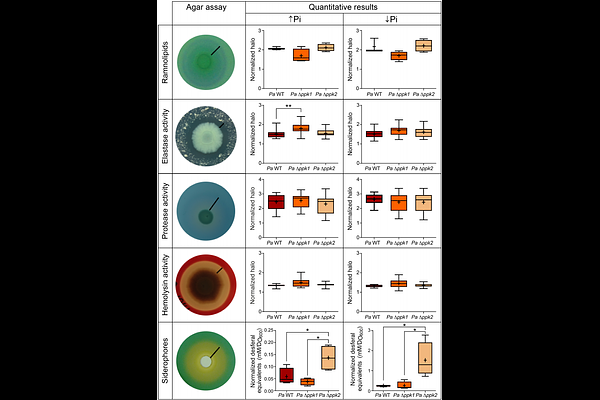
AbstractUnderstanding how bacterial metabolism shapes virulence requires infection models that are both biologically informative and experimentally accessible. Here, we used zebrafish (Danio rerio) larvae infection by static immersion as a simple and robust vertebrate model to study Pseudomonas aeruginosa host-pathogen interactions and virulence regulation. Using this approach, we show that disruption of polyphosphate synthesis by loss of ppk1 gene ({Delta}ppk1) leads to marked attenuation of virulence, whereas interrupting ppk2 gene ({Delta}ppk2) results in a hypervirulent phenotype. Phenotypic assays and quantitative proteomics revealed that loss of polyP selectively impairs pyoverdine production, with minimal effects on other canonical virulence factors. Consistently, a pyoverdine-deficient mutant ({Delta}pvdF) exhibited reduced virulence in zebrafish, validating the model's capacity to functionally resolve key pathogenic determinants. Together, our results highlight polyphosphate metabolism as a central regulator of P. aeruginosa virulence and position zebrafish immersion assays as an efficient and ethically aligned alternative to mammalian models for studying bacterial pathogenesis.