Binary White Dwarfs as Gravitational Wave Sources for LISA

Binary White Dwarfs as Gravitational Wave Sources for LISA
Sreeta Roy, Surajit Kalita, Tomasz Bulik, Dorota Gondek-Rosińska
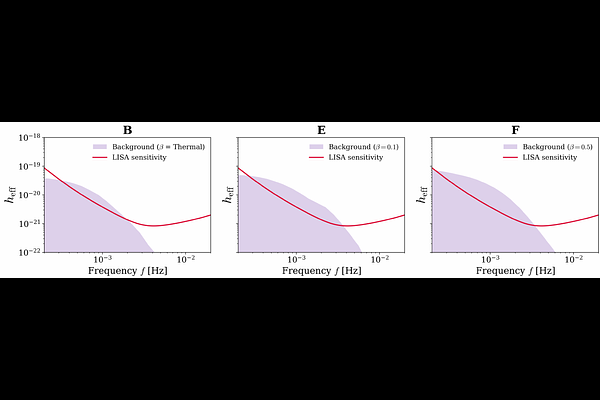
AbstractGravitational waves (GWs) have proven to be a powerful probe of compact binary populations. In the millihertz frequency range accessible to Laser Interferometer Space Antenna LISA, binary white dwarfs (BWDs) are expected to constitute a dominant source, forming both individually resolvable signals and an unresolved Galactic background. In this work, we construct a Milky Way like population model and calculate the GW background from unresolved Galactic BWD in the LISA sensitivity range, with particular emphasis on exploring and constraining uncertainties in binary stellar evolution. We employ COMPAS binary population synthesis framework to generate synthetic populations of BWD in the Milky Way. Various physically motivated evolution prescriptions and initial model parameters are used to study diverse population of BWDs. From these populations, we construct the GW background and investigate the dependence of the background spectrum on the assumptions on binary analysis. We discuss the possibility of constraints on binary evolution that LISA GW observations may yield. We find that the shape and amplitude of the background are sensitive to key binary evolution parameters like common envelope evolution and mass-transfer efficiencies. Variations in these assumptions lead to measurable differences in the predicted background spectrum. Our results demonstrate that LISA observations of the unresolved BWD background have the potential to constrain binary evolution models. This highlights the importance of GW background modelling as a complementary tool for studying the formation and evolution of compact binaries in the Milky Way.