Late infall of molecular cloud material reshaped the outer Solar System

Late infall of molecular cloud material reshaped the outer Solar System
Elishevah van Kooten, Sebastian Sjørring Lodal, Isaac Onyett, Lasse Rasmus Pohlmann, Jean Bollard, Courtney Rundhaug, Martin Schiller, Martin Bizzarro
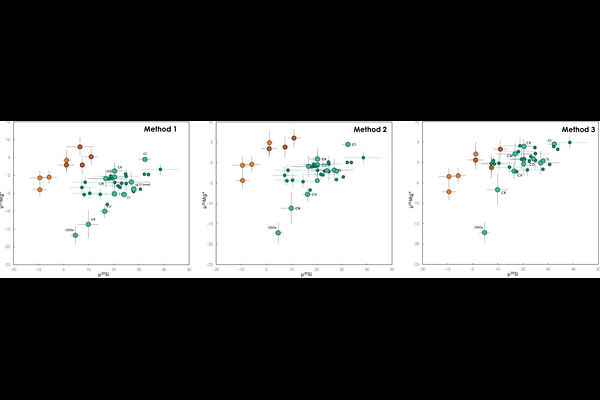
AbstractUnderstanding the physicochemical evolution of the outer protoplanetary disk is critical because it governed the distribution and delivery of key volatiles such as water and organic compounds to the inner, initially hot and volatile-poor terrestrial planet-forming region. These materials are essential for establishing potentially habitable environments and directly influence the emergence of life on rocky planets. Here, we move beyond the traditional building blocks of the outer disk, the carbonaceous chondrite groups, and examine their ungrouped counterparts, the anomalous chondrites, to constrain a coherent model of disk evolution using Si, Mg, Fe, and Cr nucleosynthetic isotope systematics. Our results show that the outer disk was replenished through the addition of isotopically distinct molecular cloud material that contributed a significant fraction of mass (>30%) to the building blocks of the gas giant accretion region. This late infalling material did not contribute to the main accretion phase of the terrestrial planets, which instead derived their volatile inventory solely from Ivuna-type planetesimals such as Ryugu and Bennu. In our model, these bodies formed at the inward-migrating water ice line. The inferred accretion of these icy planetesimals in the inner disk represents a fundamental shift in our understanding of the evolution of the Solar System.