The UPRMT is a critical mediator of nutrient immunity

The UPRMT is a critical mediator of nutrient immunity
Maruichi, A.; Zhang, H.; Viret, A. M.; Joe, L. K.; Dillin, A.
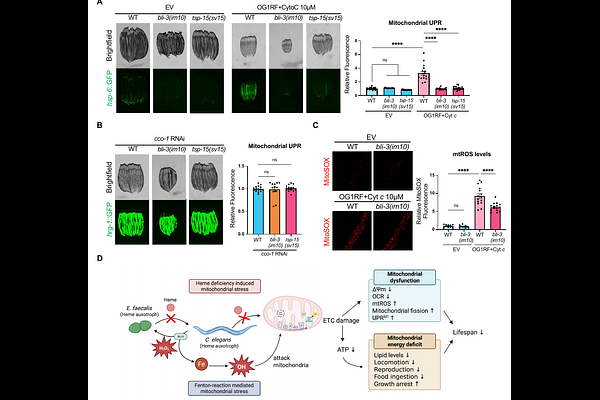
AbstractMitochondria serve as critical signaling hubs that monitor the intracellular environment to orchestrate cellular stress responses during pathogen infection. The mitochondrial unfolded protein response (UPRMT), a key surveillance pathway, is widely considered to be activated by pathogen-derived toxins that directly damage host mitochondria. In contrast to this prevailing model, we demonstrate that E. faecalis, which lacks specialized mitochondrial toxins, activates the UPRMT in C. elegans via a combination of metabolic and oxidative stress. As both C. elegans and E. faecalis are heme auxotrophs, E. faecalis-ingested animals result in severe heme deficiency, leading to the disruption of the electron transport chain and activation of the UPRMT. During live infection, this primary mitochondrial stress is further amplified due to the Fenton reaction, driven by host NADPH oxidase BLI-3-generated hydrogen peroxide. Ultimately, our findings position the UPRMT as a fundamental homeostatic sensor that monitors metabolic and oxidative imbalances at the host-pathogen interface.