Physiological basis of photosynthetic hydrogen production in the cyanobacterium Synechocystis

Physiological basis of photosynthetic hydrogen production in the cyanobacterium Synechocystis
Strabel, N.; Paul, F.; Regenbogen, J.; Boehm, M.; Appel, J.; Gutekunst, K.
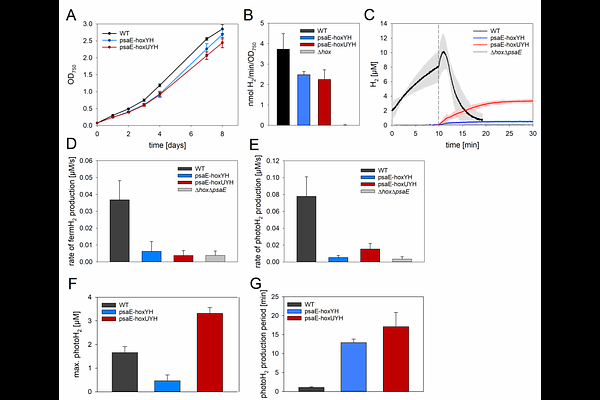
AbstractPhotosynthetic hydrogen (photoH2) production by the cyanobacterium Synechocystis sp. PCC 6803 is an attractive means for storing solar energy. However, photoH2 yields remain limited by competing electron flux pathways. Recent in vitro characterization suggests that photoH2 production requires electrons from both carbohydrate oxidation and photosynthesis. Engineered fusions between photosystem I (PSI) and hydrogenase (PSI-H2ase) aim to divert electrons toward H2 production and rely exclusively on photosynthesis. Thus, photoH2 production differs fundamentally between wildtype (WT) and PSI-H2ase fusion mutants. Here, we show that photoH2 production in WT is enhanced by supplemented glucose, consistent with the recently reported confurcating nature of HoxEFUYH H2ases. PhotoH2 production was further studied in the new psaE-hoxUYH mutant by simultaneously monitoring electron flux through PSI alongside with turnover rates of O2, CO2 and H2. PsaE-hoxUYH achieved the highest photoH2 yield and longest production period among the currently available PSI-H2ase mutants in Synechocystis, prolonged by removing O2. Upon illumination, psaE-hoxUYH exhibited high initial photoH2 production rates, which decreased in parallel with CO2 fixation and ceased immediately in the presence of O2. In absence of O2, photoH2 production still declined slowly. Therefore, in addition to CO2 fixation and O2, other yet unknown factors might limit photoH2 production under these conditions. Moreover, we traced a previously observed high H2 production phase of unclear origin in psaD-hoxYH cultures to contaminating [FeFe] H2ases from Clostridium intestinale rather than genuine photoH2 production by the mutant. Together, these findings indicate a complex metabolic interplay tuning photoH2 production in Synechocystis WT and PSI-H2ase fusion mutants.