Synthetic budding morphogenesis by optogenetic receptor tyrosine kinase signaling

Synthetic budding morphogenesis by optogenetic receptor tyrosine kinase signaling
Prahl, L. S.; Canlla, R.; Huang, A. Z.; Alber, D. S.; Shefter, S. L.; Davis, S. N.; Grindel, S. H.; Huang, Z.; Mumford, T. R.; Benman, W.; Bugaj, L. J.; McCracken, K.; Hughes, A. J.
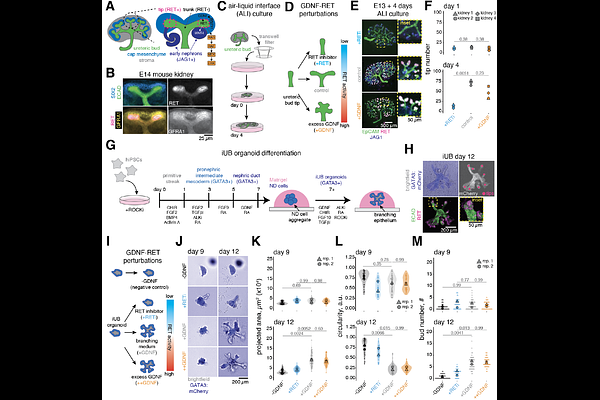
AbstractThe mammalian kidney relies on a branched network of collecting ducts for fluid transport and homeostasis. Replicating this network in vitro would parallelize function in synthetic replacement kidneys, yet current organoids have limited branching capacity. Here, we establish a developmentally-informed strategy to control organoid budding through optogenetic control of a receptor tyrosine kinase, RET. We first show pharmacological manipulation of RET signaling controls the extent of branching in mouse embryonic kidneys and human stem cell-derived kidney organoids. Next, we develop an optogenetic RET receptor (optoRET) that signals in a ligand-independent manner via blue light-mediated clustering. Epithelial cells expressing optoRET reproduce stereotyped RET signaling, scattering, and symmetry breaking in response to blue light. Human kidney organoids undergo budding with controllable orientation in response to spatially patterned optoRET stimulation. Our results establish ligand-free optogenetic control of branching and inspire new synthetic biology strategies for epithelial organoid design.