Rational Design Reveals Structural Plasticity of the CsgA β-Solenoid Enabling Programmable Autogenic Engineered Living Materials

Rational Design Reveals Structural Plasticity of the CsgA β-Solenoid Enabling Programmable Autogenic Engineered Living Materials
Hammad, H.; Swarnadeep, S.; Priode, H.; Jackson, E.; Kurowski, A.; Moore, R.; Manjula-Basavanna, A.; Deshmukh, S.; Duraj-Thatte, A.
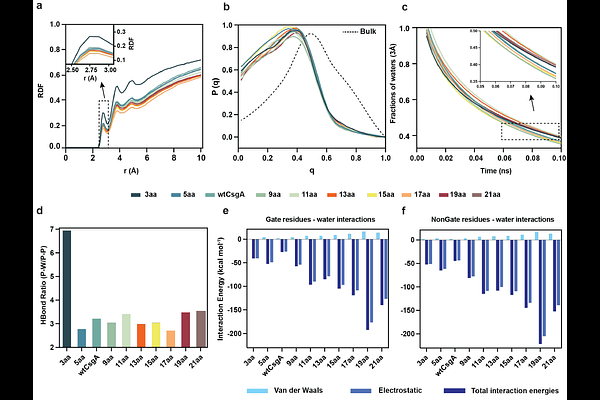
AbstractMicrobial functional amyloids play central roles in biofilm formation and serve as foundational building blocks for autogenic engineered living materials (ELM), yet the structural design space governing their assembly and stability remains poorly defined. In Escherichia coli, the {beta}solenoid protein CsgA functions as a canonical extracellular matrix scaffold, but prior engineering efforts have primarily focused on terminal functionalization rather than modification of the {beta}solenoid core itself. Here, inspired by the evolutionary diversification of CsgA like proteins, which expands along the vertical fiber axis, we explore a second orthogonal axis of structural plasticity: the horizontal dimension of the {beta}solenoid. We rationally designed a library of CsgA variants in which the length of individual {beta}-strands was systematically reduced or extended from the native seven residues to lengths spanning 3 to 21 residues, while preserving conserved gate residues and loop regions. Integration of AI-based structure prediction using AlphaFold2 with all-atom molecular dynamics simulations reveals that {beta}solenoid stability arises from a balance among strand length, residue composition, and solvent interactions, thereby defining both lower and optimal bounds for nanofiber assembly. Experimental validation demonstrates that engineered Escherichia coli can secrete and assemble these CsgA variants into extracellular nanofibers through the native curli biogenesis machinery, while preserving the characteristic cross{beta} architecture. Additionally, the CsgA {beta}solenoid variant library translates molecular design into macroscopic ELM, with deletion variants showing an inverse relationship between stiffness and extensibility, from highly extensible 3aa to stiff, strong 5aa films. Insertion-based variants largely retain CsgA-like extensibility while enabling tunable stiffness and strength across strand lengths. Together, these findings uncover previously unrecognized structural plasticity in microbial{beta}solenoid proteins and establish {beta}strand length as a generalizable design parameter linking molecular architecture to nanofiber stability, with implications spanning microbial functional amyloids and the rational design of autogenic engineered living materials.