Cosmic Ray Observations using Coincident Scintillator and Radio Signals with the Beamforming Elevated Array for COsmic Neutrinos (BEACON)

Cosmic Ray Observations using Coincident Scintillator and Radio Signals with the Beamforming Elevated Array for COsmic Neutrinos (BEACON)
Zachary Martin, Jackson Hinkel, Kira Perna, Andrew Zeolla, Jaime Alvarez-Muñiz, Sergio Cabana-Freire, Washington Carvalho, Austin Cummings, Cosmin Deaconu, Kaeli Hughes, Ryan Krebs, Youwei Liu, Marek Michulka, Katharine Mulrey, Alisa Nozdrina, Eric Oberla, Steven Prohira, Andrés Romero-Wolf, Abigail G. Vieregg, Stephanie A. Wissel, Enrique Zas
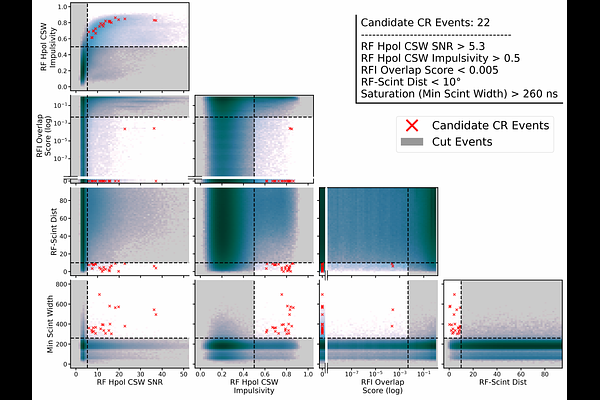
AbstractAt energies above 100 PeV, coherent radio frequency (RF) emission across the 10 -- 1000 MHz band from cosmic particle-induced atmospheric showers becomes increasingly dominant, making radio detection a powerful probe at ultrahigh energies. The Beamforming Elevated Array for COsmic Neutrinos (BEACON) considers mountaintop phased radio arrays to monitor large areas at the horizon for upward-going geomagnetic emission in the 30 -- 80 MHz band produced as a consequence of Earth-skimming tau neutrinos. As part of ongoing efforts to measure the sensitivity of BEACON to such signals, the BEACON prototype identifies cosmic rays through the same emission mechanism. Prior to 2023, BEACON operated a four-antenna prototype, which successfully demonstrated identification of coherent and impulsive sources using a beamforming RF trigger. In 2023, we upgraded the instrument to six newly designed antennas and added an independent scintillator array to cross-validate radio-detectable cosmic rays. This work details the observation of 22 candidate cosmic-ray events in a scintillator-coincidence-triggered dataset using selection cuts based on expected radio characteristics. A simulation of the hybrid-instrument performance verifies this observation rate to within an order of magnitude. We estimate a background of 0.11 events by applying the selection cuts to synthetic datasets of uncorrelated radio-scintillator pairs that are randomly formed using fixed-rate software-triggered data. The reconstructed signal polarization angles are consistent with pure geomagnetic emission compared to various background classes.