Mineral False Positives in the Search for Exoplanet Surface Biosignatures

Mineral False Positives in the Search for Exoplanet Surface Biosignatures
Mia Belle Parkinson, Lisa Kaltenegger, Beth Biller, Grant Lach, Sean McMahon
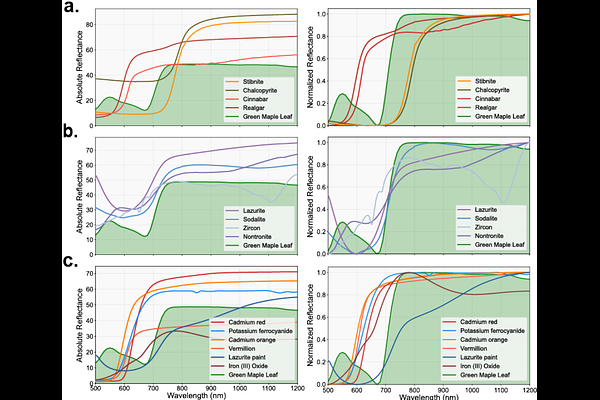
AbstractIn the search for life in the cosmos, biopigments on exoplanet surfaces are a critical target. Such pigments have been detected in Earth's spectrum (by the Galileo spacecraft and in Earthshine) via the "vegetation" or "photosynthesis red edge" (VRE or PRE), a sharp, step-like increase in reflectance with increasing wavelength at ~700 nm. Future space telescopes like the Habitable Worlds Observatory (HWO) are designed to obtain disk-integrated spectra of Earth-like exoplanets in the visible-to-near-infrared to identify such features. However, there has been no systematic analysis of the occurrence of similar reflectance edges among minerals of non-biological origin. Here, we use existing databases of mineral reflectance spectra to explore the risk that minerals may present false positives in the search for biopigments on exoplanets. We find that several sulfide and tectosilicate minerals, as well as the prebiotically important cyanide salt, potassium ferrocyanide, have PRE-like features. We characterize these features in order to assess how they may be distinguished from biopigments. We conclude that the future evaluation of the biogenicity of PRE-like features in exoplanet reflectance spectra can be informed by the atmospheric context, but may require an assessment of the prior probability of non-biological and biological hypotheses about the surface materials of exoplanets.