Splenic tropism of Plasmodium vivax in acute infection and spleen-attenuated systemic inflammation

Splenic tropism of Plasmodium vivax in acute infection and spleen-attenuated systemic inflammation
Kho, S.; Rini, H.; Kambuaya, N. N.; Satria, S.; Candrawati, F.; Shanti, P. A.; Alexander, K.; Andries, B.; Amelia, A. R.; Rai, A.; Piera, K. A.; Puspitasari, A. M.; Amalia, R.; Prayoga, P.; Leonardo, L.; Hafidzah, M.; Situmorang, T.; Margayani, D. S.; Rahmayenti, D. A.; Cao, P.; Kenangalem, E.; Trianty, L.; Oyong, D.; Simpson, J. A.; Noviyanti, R.; Buffet, P. A.; Poespoprodjo, J. R.; Anstey, N. M.
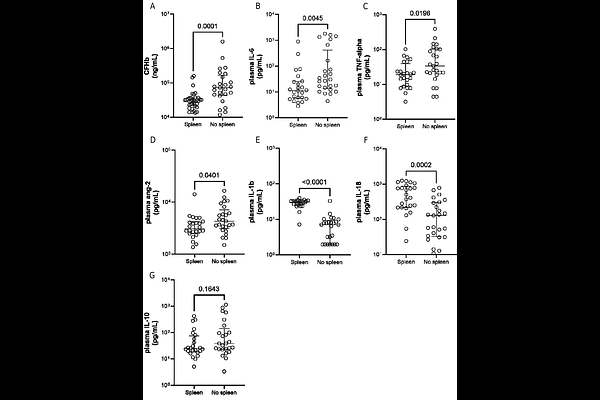
AbstractBackground: In chronic asymptomatic Plasmodium vivax infections, the spleen accounts for more than 98% of total-body parasite biomass. Whether this splenic tropism also exists in acute infection and how the spleen influences pathogenesis have not been systematically explored. Materials and Methods: In Papua, Indonesia, we compared plasma levels of P. vivax lactate dehydrogenase [PvLDH]) and circulating parasitemia in 24 spleen-intact and 25 previously splenectomized patients with acute uncomplicated vivax malaria. Clinical and hematology data were collected and plasma markers of intravascular hemolysis (cell-free hemoglobin [CFHb]), endothelial activation (angiopoietin-2), inflammation (interleukin [IL]-1 beta, IL-6, IL-18, IL-10, tumor necrosis factor-alpha) and neutrophil activation (elastase) were measured by ELISA. Giemsa-based histology in one spleen from an untreated patient splenectomized for trauma during an episode of acute vivax malaria enabled direct assessment of splenic and circulating parasitemia and biomass microscopically. Results: Circulating parasitemia was 4-times higher in splenectomized compared to spleen-intact patients (median 21,100 vs 4,820 parasites/L, p=0.0002) but total-body P. vivax biomass (PvLDH) was 3-times lower in patients without a spleen (median 721 vs 2,140 ng/mL, p=0.026). Parasite staging and greater organ-specific symptoms suggest redistribution of parasites in the absence of a spleen. Linear regression modeling, adjusting for circulating parasitemia, patient age, sex and duration of fever, demonstrated an 8.1-fold higher PvLDH concentration in spleen-intact patients (95% confidence interval [CI]: 3.4-19.5-fold, p<0.0001), indicating a splenic biomass accounting for 89% (95%CI: 77.3-95.1%) of total-body parasites. Histopathology revealed a spleen-to-blood biomass ratio of 10.7, in-line with the PvLDH-based estimate. In spleen-intact patients, splenic P. vivax biomass correlated strongly with markers of disease intensity, endothelial activation and systemic inflammation, whereas circulating parasitemia correlated weakly or not at all. Compared to spleen-intact patients, CFHb, endothelial activation and systemic inflammation were higher in splenectomized patients while inflammasome-dependent responses were lower. Conclusions: P. vivax is predominantly an infection of the spleen, even in acute clinical vivax malaria. We conservatively estimate that 89% of total-body parasite biomass in acute infection is splenic. While the size of this hidden population correlates with disease intensity, the spleen likely regulates inflammatory pathways and heme-associated pathology.