Testing Theories of Solar Coronal Heating with Three-Dimensional Forward Modeling

Testing Theories of Solar Coronal Heating with Three-Dimensional Forward Modeling
Steven R. Cranmer, Chris R. Gilly
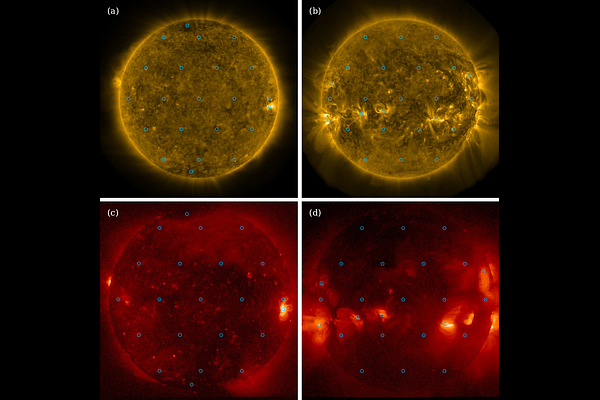
AbstractAfter almost a century of speculation, the physical processes responsible for heating the Sun's corona remain uncertain. Observations of coronal loops at extreme ultraviolet and X-ray wavelengths have provided substantial insights, such as the constraint that heating rates increase monotonically with local magnetic field strength. However, there remain dozens of competing suggestions for detailed theoretical explanations of the heating. There remains a need to compare the predictions of these theories with one another, and with real data, so the most likely mechanisms can be determined. In this paper, we build three-dimensional simulations of the corona by starting with potential-field extrapolations for the magnetic field, filling in plasma densities and temperatures along individual loops using one-dimensional models, then computing optically thin intensities for comparison with data from the Solar Dynamics Observatory and Hinode. One new aspect of this forward modeling is the use of parameterizations for heating that include a wide variety of processes such as wave dissipation, reconnection, nanoflares, and turbulent cascade. We also include the effects of intermittent heating and cooling along unresolved strands in the form of time-averaged multithermal broadening of the local differential emission measure. After allowing the coronal heating prescription to vary freely, we found a narrow range of parameters that produce optimal agreement with a set of more than 500 independently measured intensities at solar minimum and maximum. The values of these parameters are consistent with those predicted by models of imbalanced magnetohydrodynamic turbulence, but this does not necessarily exclude contributions from other heating processes.