A self-organized geometry sensing oscillator spatially regulates cell division in archaea

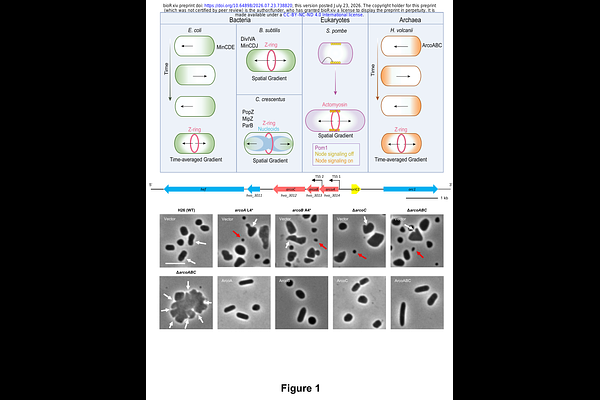
A self-organized geometry sensing oscillator spatially regulates cell division in archaea
Du, S.; Zheng, W.; Zhao, S.; Liu, Y.; Chen, Z.; Wu, J.; Zou, X.; Cui, J.; Chen, X.; Lutkenhaus, J.; Wu, F.
AbstractMany bacteria and eukaryotes employ geometry sensing systems to regulate cell division spatiotemporally. However, how archaea ensure they divide in the right place at the right time is little understood. Here, we report the discovery of a geometry sensing oscillator that determines the division plane in the model haloarcheon Haloferax volcanii, which relies on two tubulin-like proteins, FtsZ1 and FtsZ2, for division. This archaeal oscillator (named as Arco system) is composed of three components, ArcoA, ArcoB and ArcoC, which are a membrane associated Ras superfamily GTPase, a SepF-like protein and an antagonist of FtsZ1, respectively. ArcoA interacts with both ArcoB and ArcoC. ArcoAB sense the geometry of the cell to oscillate between the two cell poles, generating a time-averaged ArcoC gradient which is high at the cell poles but low at the midcell, where FtsZs can assemble into the Z ring to initiate cytokinesis. As a result, deletion of the Arco system caused aberrant FtsZ assembly throughout the cell, leading to irregular division and formation of minicells. Interestingly, the Arco system is globally distributed among archaea and co-occurs with FtsZ1, suggesting that it emerged in the last archaeal common ancestor (LACA). The oscillatory behavior and phenotypes of the archaeal Arco system is remarkably analogous to the bacterial Min system and yet share no protein homology, representing a remarkable example of convergent evolution. Overall, these results suggest that archaea, similar to bacteria and eukaryotes, independently evolved self-organized Turing reaction diffusion systems to sense geometry and spatially regulate cell division.