Synthesis imaging with a lunar orbit array: I. global sky map and its systematics

Synthesis imaging with a lunar orbit array: I. global sky map and its systematics
Furen Deng, Yidong Xu, Fengquan Wu, Yanping Cong, Bin Yue, Xuelei Chen
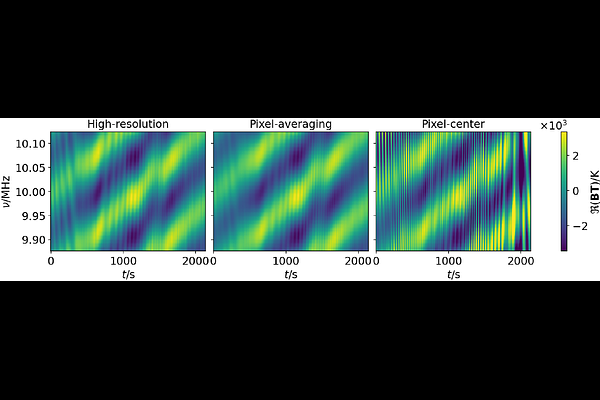
AbstractGround-based radio astronomical observation at frequencies below 30 MHz is hampered by the Ionosphere and radio frequency interference (RFI). The Discovering Sky at the Longest wavelength (DSL) mission, also known as the Hongmeng mission, employs a linear array of satellites on a circular orbit around the Moon to make interferometric observations in this band. Though vastly different from the usual ground-based arrays, the interferometric visibility data collected by such an array is linearly related to the sky map, and the reconstruction is in principle an inversion problem of linear mapping. In this paper, we investigate a number of issues in the algorithm of global map reconstruction, focusing on the impact of sub-pixel noise induced by the finite pixelization of the sky, and errors due to regularization. We find that in the reconstruction process, if one builds up the beam matrix, which relates the sky pixels to the visibilities, by naively evaluating its elements at each of the pixel centers, then the sub-pixel noise can give rise to a significant aliasing effect. However, this effect can be effectively mitigated by a simple pixel-averaging method. Based on evaluation of the image quality using the correlation coefficient between the input and reconstructed map, and the signal-to-noise ratio, we discuss the selection strategy of the regularization parameter, and show that the sky can be well reconstructed with a reasonable choice of the regularization parameter.