Bright Galaxies at Cosmic Dawn: A Cloud-Scale Star Formation Model Unifying Variable SFE, IMFs, and Stochasticity

Bright Galaxies at Cosmic Dawn: A Cloud-Scale Star Formation Model Unifying Variable SFE, IMFs, and Stochasticity
Elie Cueto, Anne Hutter
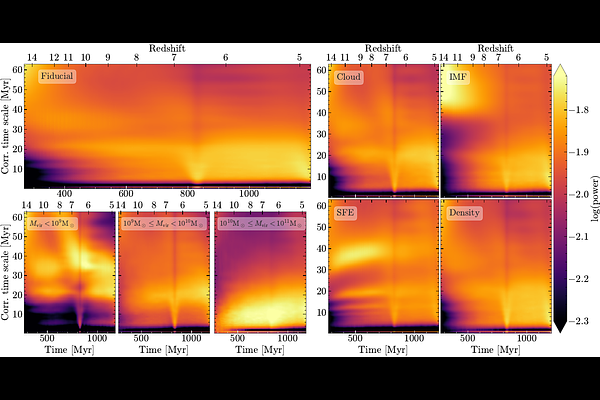
AbstractTo investigate the origins of the high abundance of UV-bright galaxies at z > 10, we present a new semi-analytic model that bridges the gap between small-scale star formation physics and large-scale galaxy evolution by explicitly tracking discrete star-forming clouds within smoothly evolving dark matter potentials. Unlike conventional semi-analytic models, our approach naturally captures the stochasticity of star formation, allowing us to isolate how cloud properties, star formation efficiencies (SFEs), and stellar initial mass functions (IMFs) shape the star-formation burstiness of early galaxies. Clouds are drawn sequentially from a cloud mass distribution, assigned an SFE and IMF depending on cloud mass, metallicity, and redshift, and evolve under the influence of short-timescale stellar feedback. We identify three distinct star formation regimes arising from the interplay between cloud masses, densities, and feedback timescales: a stochastic, feedback-limited regime in low-mass halos with long quiescent phases; a bursty regime regulated by the cloud mass distribution; and a smooth, continuous regime in massive halos. Our fiducial model adopts a dynamic IMF, an SFE linked to cloud properties and the IMF, and massive, moderately dense clouds. Varying assumptions reveals that top-heavy IMFs and enhanced SFEs in massive clouds amplify burstiness, while altering the upper cloud mass or density normalisation is secondary. Among model ingredients, the IMF most strongly impacts the UV luminosity function (LF), while switching to a constant SFE boosts the faint end, and reducing the maximum cloud mass decreases the bright end. These results demonstrate that cloud-scale physics critically shape early galaxy UV luminosity distributions.