Evolution of Low-Mass Population III Stars: Convection, Mass Loss, Nucleosynthesis, and Neutrinos

Evolution of Low-Mass Population III Stars: Convection, Mass Loss, Nucleosynthesis, and Neutrinos
Thiago Ferreira, Earl P. Bellinger, Ebraheem Farag, Christopher J. Lindsay
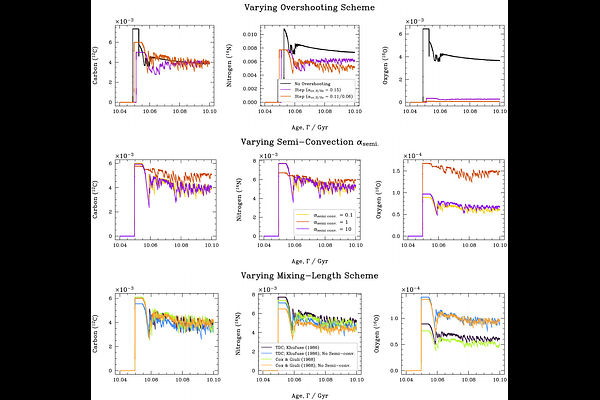
AbstractThe first stars likely formed from pristine clouds, marking a transformative epoch after the dark ages by initiating reionisation and synthesising the first heavy elements. Among these, low-mass Population III stars are of particular interest, as their long lifespans raise the possibility that some may survive to the present day in the Milky Way's stellar halo or satellite dwarfs. As the first paper in a series, we present hydrodynamic evolutionary models for 0.7 - 1 MSun stars evolved up to the white dwarf phase, utilising the MESA software instrument. We systematically vary mass-loss efficiencies, convective transport, and overshooting prescriptions, thereby mapping how uncertain physics influences nucleosynthetic yields; surface enrichment, including nitrogen-rich post-main sequence stars arising from convective shell mergers; remnant properties, such as low-mass helium or carbon-oxygen white dwarfs (M_WD ~ 0.45-0.55 MSun) and transient UV-bright phases; and potential observational signatures, including neutrino emission during shell mergers and helium flashes. These models establish a predictive framework for identifying surviving Pop III stars and their descendants, providing both evolutionary and observational constraints that were previously unexplored.