An overview of stray light findings and interpretation during on-sky commissioning of LSSTCam

An overview of stray light findings and interpretation during on-sky commissioning of LSSTCam
Gabriele Rodeghiero, Alex Drlica-Wagner, Alessio Taranto, Luca Rosignoli, Hannah Pollek, Aashay Pai, Lynne Jones, Erin Howard, Sean MacBride, John Andrew, Douglas Neill, Travis Lange, Andrew Rasmussen, Aaron Roodman, Brian Johnson, Elana Urbach, Parker Fragelius, Eli Rykoff, Tomislav Vucina, Christopher Stubbs, Robert Lupton, Charles Claver, Joshua Meyers, Anastasia Alexov, Keith Bechtol, Lee Kelvin, Brian Stalder, Pierre Antilogus, Alexandre Boucaud, Aurelien Marini, Alexander Broughton, Leanne Guy, Tiago Ribeiro, Erik Dennihy, Bruno Quint, Aaron Watkins, Alysha Shugart, Lukas Eisert, Kevin Fanning, Marina Pavlovich, Yijung Kang, Hye Park, Paulo Lago, Kristopher Mortensen, Paulina Venegas Salas, Minhee Hyun, Karla Peña Ramírez, David Sanmartim, Shuang Liang, Gonzalo Aravena, Kshitija Kelkar, Kate Napier, Jacqueline Seron Navarrete, Carlos Morales Marín, Danica Žilková, Narayan Khadka, Eric Christensen, Yousuke Utsumi, Merlin Fisher-Levine, Yusra Alsayyad, Colin Slater, Fritz Müller, William O'Mullane, Enrico Giro, Rodolfo Canestrari, Guillem Homar Megias, Sandrine Thomas, Kevin Reil, Roberto Tighe, Mario Rivera, Juan Lopez, Claudio Araya Cortes, David Jiménez Mejías, Hernán Herrera, Freddy Muñoz Arancibia, Dimitri Buffat, Johan Bregeon, Jacques Sebag, Holger Drass, Pablo Zorzi, Massimo Brescia
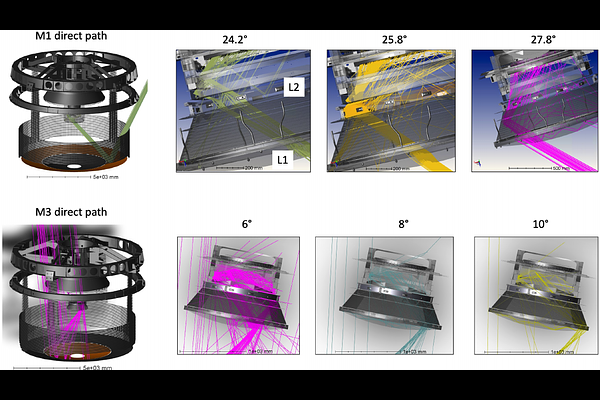
AbstractWide-field telescopes are intrinsically difficult to shield from unwanted stray and scattered light, while the search to identify sources of contaminating light is frequently a challenging task. The Vera C.~Rubin Observatory, which achieved its first photon with the LSST Camera (LSSTCam) on April 15, 2025, will initiate a revolutionary era for the study of dark matter, dark energy, the transient sky, the Solar System, and the Milky Way. LSSTCam will provide near seeing-limited images of the sky in six bands ($u,g,r,i,z,y$) over a $3.^\circ 5$-diameter field of view, and over the course of a decade, it will execute the Legacy Survey of Space and Time (LSST). This work provides an overview of the dedicated stray and scattered light test campaign that has been undertaken since the start of Rubin commissioning. In particular, we highlight the processes used to characterize, model, and mitigate stray light present in LSSTCam images. The Rubin commissioning team created a series of testing and analysis tools to track stray light artifacts from their initial discovery through reproduction with timely observations, simulation using ray tracing to identify opto-mechanical origins, and finally devising corrective actions. The complex stray light features encountered by Rubin provide a wealth of experience for the future wide-field and extremely wide-field observatories. This work covers the many stages of a long journey that started with conceiving an innovative and challenging optical design, followed by the engineering and system engineering efforts to build it, to finally delivering an optimized and revolutionary cutting-edge facility.