Pulsation-driven helium transport as a potential source of the Blazhko effect

Pulsation-driven helium transport as a potential source of the Blazhko effect
Geza Kovacs
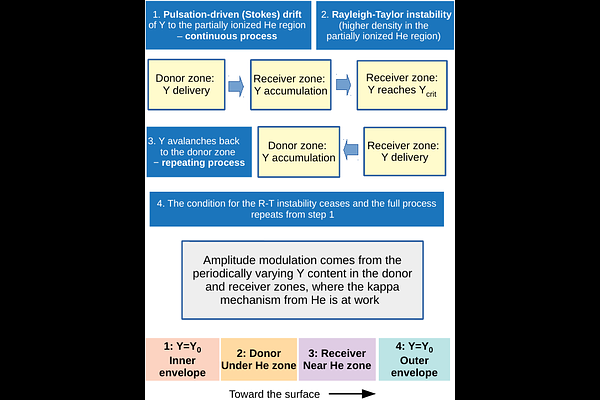
AbstractWe present a highly simplified nonlinear hydrodynamical model to emulate the main observed features of amplitude modulation (commonly known as Blazhko effect) in RR Lyrae stars. The model is based on the assumption that the periodic flow generated by the pulsation carries surplus helium in the ionization zones He I and II. Once this extra helium reaches a critical amount, a Rayleigh-Taylor-type instability leads to a back-flow of the surplus helium and the process starts over again, due to the continuing effect of pumping helium upward by the pulsation. This periodic variation of helium leads to various efficiency of radiation flux blocking in the helium ionization zone that shows up as a long-term periodic variation of the pulsation amplitude.