Defining the molecular interaction between influenza hemagglutinin and MHC-II

Defining the molecular interaction between influenza hemagglutinin and MHC-II
Dadonaite, B.; Dosey, A.; Ahn, J. J.; Yu, T. C.; Sunshine, S. A.; Farrell, A. G.; King, N. P.; Bloom, J. D.
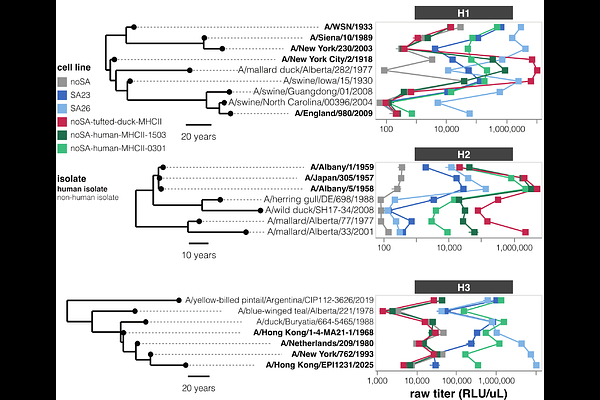
AbstractThe hemagglutinin (HA) of some influenza viruses can interact with major histocompatibility complex class II (MHC-II), but how these proteins interact is unclear. Here we demonstrate that diverse H5 HAs can use MHC-II to enter cells, with avian MHC-II enabling more efficient entry than human MHC-II for most H5 HAs. To define the molecular interface, we use pseudovirus deep mutational scanning to measure how mutations to H5 HA affect its interaction with tufted duck MHC-II, and identify mutations that restrict HA to exclusively MHC-II or sialic acid receptors. We leverage identification of H5 HA mutations that increase binding to tufted duck MHC-II to determine a 4.8 [A] cryo-EM model of the complex. To support the structural model, we measure how all mutations to tufted duck MHC-II affect its interaction with H5 HA, and find the alpha chain is the dominant determinant but beta chain sites near the peptide-binding groove also contribute. To generalize these findings, we use deep mutational scanning to show that a H7 HA interacts with MHC-II similarly to H5 HA. Finally, we show that H1, H2, H3, and H9 HAs interact with avian or human MHC-II, although interactions vary among strains that evolved in different hosts.