Water gas discs in exo-asteroid belts

Water gas discs in exo-asteroid belts
Paul Huet, Quentin Kral, Louis Manchon
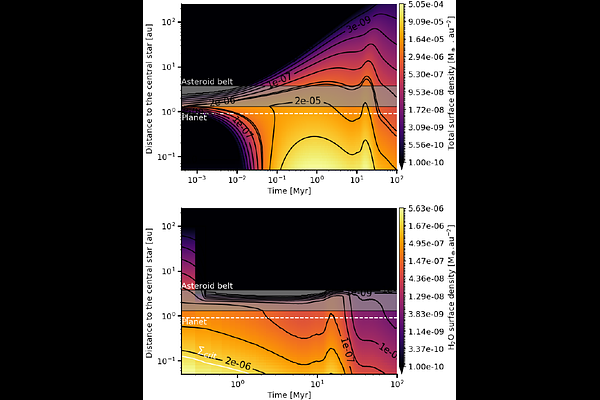
AbstractObservations of tens of secondary CO gas discs associated with cold exo-Kuiper belts together with other arguments have led Kral et al (2024) to propose that water ice could also sublimate in exo-asteroid belts, suggesting a new pathway for the delivery of water to terrestrial planets, including Earth. We aim to model such water vapour discs and to characterise their physical properties across a range of extrasolar systems with different host stars. We further investigate the implications for the accretion of this water by potential planets located in the inner regions of these systems. We adapt and extend the model of Kral et al (2024) to follow the outgassing, photodissociation, and viscous evolution of water vapour discs. We perform a suite of simulations exploring the parameter space, focusing on the stellar mass, the mass of the parent belt, and its orbital location. We additionally include an inner planet to estimate the mass of water accreted as a function of disc properties and system architecture. We find that systems hosting Sun's mass (and higher) stars produce water vapour very efficiently, sublimating nearly all of the ice initially present in the belt. In most cases, the bulk of the gas mass is generated early, when the stellar luminosity is highest. The amount of water accreted by inner planets can approach the initial ice mass of the belt, leading to planets with water inventories comparable to or exceeding those of Earth, potentially creating ocean planets. We find that water outgassing occurs early after the protoplanetary disc dissipates in systems containing exo-asteroid belts. ALMA, JWST and ELT are capable of detecting this water vapour for several tens of millions of years, even in relatively low-mass water discs. Hence, if such water gas discs are present, they should be detectable with current facilities.