Sexual Selection as a Mechanism of Evolutionary Information Preservation

Sexual Selection as a Mechanism of Evolutionary Information Preservation
Erden, Z. D.
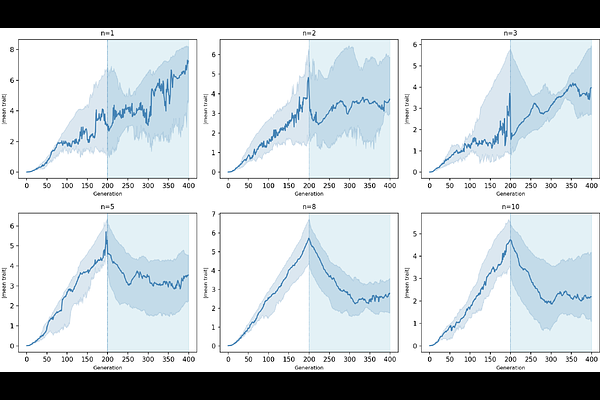
AbstractSexual selection is among the most pervasive and costly features of biological reproduction, reaching its greatest elaboration in lineages of greater complexity and capability - costs that signal a structural function not adequately accounted for by only the existing explanations focused on immediate adaptive benefits. I propose that this function is the long-term preservation of evolutionary information: through Fisherian co-evolution between female preferences and male traits, historically adaptive traits are sustained beyond the environmental pressures that originally favoured them and can be rapidly reactivated should those conditions recur, making sexually selecting lineages more efficient responders to fluctuating environments. I test this with an agent-based simulation in which male trait and female preference vectors co-evolve across alternating selective and neutral phases; across a wide range of conditions, any degree of female choosiness consistently preserves previously selected traits substantially better than random mating, with female preferences themselves forming a more durable archive than the expressed trait. The results carry implications for evolutionary theory and for the design of artificial life systems in which long-term retention of adaptive structure is a relevant property.