A Hycean Interpretation of K2-18b Supported by Photochemical Atmospheric Compositional

A Hycean Interpretation of K2-18b Supported by Photochemical Atmospheric Compositional
Takuya Fujisawa, Masashi Shimada, Tatsuya Yoshida, Kiyoshi Kuramoto
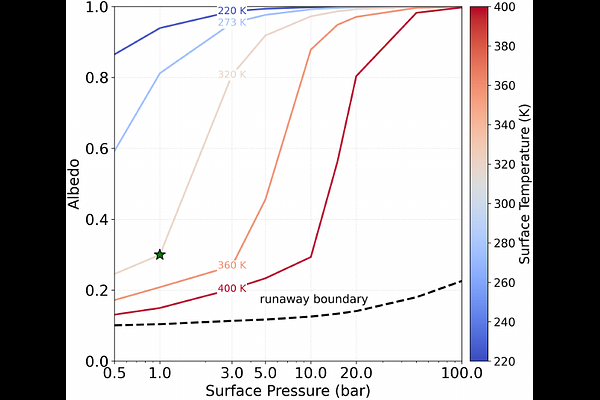
AbstractThe nature of the sub-Neptune K2-18b is debated between Hycean and mini-Neptune interpretations. We test whether self-consistent Hycean atmospheres are compatible with current JWST transmission spectra by combining one-dimensional photochemical modelling, radiative--convective equilibrium calculations, and forward modelling of transmission spectra. We assume H2-CH4-H2O atmospheres over a liquid ocean, compute altitude-dependent abundances with a 1D photochemical model, and couple them to P-T profiles that avoid runaway greenhouse states. Using the CH4-dominated 2.8-4.0 $μ$m band, we constrain wavelength-independent offsets between NIRISS SOSS and NIRSpec G395H for multiple reductions, and then scan grids of CO and CO2 scaling factors, weighted by the CH4-band offset posteriors, to evaluate oxidised-carbon abundances consistent with the 4-5 $μ$m region. Radiative--convective calculations further map pressures and albedos that yield non-runaway climates. Over a wide range of temperatures and pressures, liquid oceans can exist, and Hycean models with a 1 bar H2 envelope, percent-level CH4 and CO, and CO2 buffered at $\sim 10^{-3}$-$10^{-2}$ reproduce the NIRISS and NIRSpec spectra from 0.8 to 5.2 $μ$m without invoking DMS or other additional species. Our photochemical simulations show that H2-CH4-H2O networks generically drive CO to mixing ratios of order 1-2 %. Mass-balance arguments imply that a $\sim$1 bar H2 envelope with percent-level CH4 requires interior replenishment on gigayear timescales, and the resulting vertical gradients naturally generate flat, CH4-dominated plateaux in transmission. While mini-Neptune scenarios remain viable, our results show that Hycean configurations are likewise consistent with the data, and current CO and CO2 constraints alone are not yet sufficient to rule out Hycean interpretations of K2-18b.