An OASIS of Lyman-$α$ within a neutral intergalactic desert: reaffirmed line and blue continuum reveal efficient ionising agents at $z = 13$

An OASIS of Lyman-$α$ within a neutral intergalactic desert: reaffirmed line and blue continuum reveal efficient ionising agents at $z = 13$
Joris Witstok, Stefano Carniani, Peter Jakobsen, Andrew J. Bunker, Alex J. Cameron, Francesco D'Eugenio, Kevin Hainline, Jakob M. Helton, Tobias J. Looser, Pierluigi Rinaldi, Brant Robertson, William M. Baker, Stéphane Charlot, Benjamin D. Johnson, Gareth C. Jones, Nimisha Kumari, Roberto Maiolino, Jan Scholtz, Sandro Tacchella, Christopher N. A. Willmer, Chris Willott, Zihao Wu
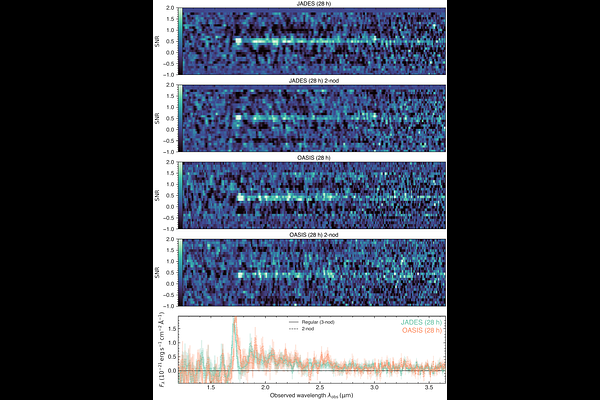
Abstract$\require{mediawiki-texvc}$Galaxy assembly was already well underway in the first 400 Myr of cosmic time, as recently revealed by JWST. However, the contribution of these early galaxies to cosmic reionisation remains uncertain. Here we present new JWST/NIRSpec observations of GS-z13-1-LA obtained as part of the OASIS and JADES programmes, whose combined deep (56 h) NIRSpec/PRISM spectrum confirms the Lyman-$\mathrmα$ line detection and blue UV continuum at redshift $z = 13.1$ presented in a previous work. The measured Lyman-$\mathrmα$ emission (rest-frame equivalent width of $66_{-9}^{+10}\,Å$) and steep continuum slope ($β_\text{UV} \approx -3$) point towards GS-z13-1-LA hosting a remarkably hot and powerful ionising source, and allow at most a modest contribution from the nebular continuum. The steep turnover of the continuum is still present, but less pronounced in the new OASIS spectrum. Combined, this implies that ionising photons may escape GS-z13-1-LA at a sufficient rate to weaken the other, still undetected UV lines, and to lead the formation of a small ionised bubble ($R_\text{ion} \approx 0.2\,\mathrm{pMpc}$). A yet larger bubble could alleviate the required ionising production efficiency of GS-z13-1-LA from $ξ_\mathrm{ion} \approx 10^{26.4}\,\mathrm{Hz\,erg^{-1}}$ down to $\approx 10^{25.9}\,\mathrm{Hz\,erg^{-1}}$, still extremely high but more readily reconcilable with stellar models. In turn, this would require a notable overdensity of galaxies with highly efficient ionising capabilities, a scenario for which tentative evidence is found in the form of 16 nearby photometric candidates and one spectroscopically confirmed source, JADES-GS-z13-0. The new OASIS observations therefore confirm the overall picture of GS-z13-1-LA as an early beacon of reionisation, providing compelling evidence for its start only 330 Myr after the Big Bang.