Anomalously high deuterium fractionation in a galactic translucent cloud: a challenge to chemical models

Anomalously high deuterium fractionation in a galactic translucent cloud: a challenge to chemical models
Gan Luo, Zhi-Yu Zhang, Thomas G. Bisbas, Di Li, Serena Viti, Roberto Neri, Junzhi Wang, Siyi Feng, Ningyu Tang, Daniel R. Rybarczyk, Lingrui Lin
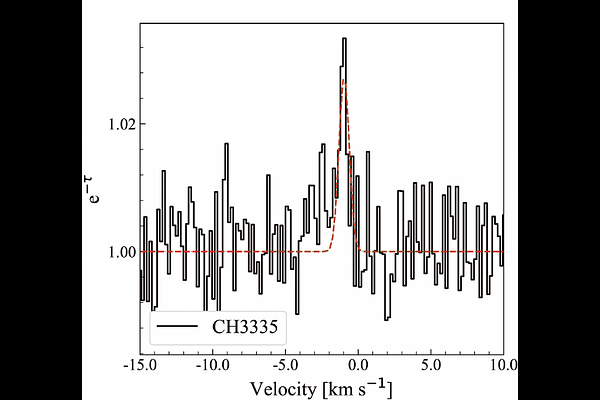
AbstractDeuterated (D-) species have long been proposed to diagnose the physical conditions and chemical evolution of cold dense molecular clouds. While deuterium fractionation has been extensively measured in dense cores, observations in diffuse and translucent clouds remain rare. We report here the detection of DCN and DNC toward a translucent cloud ($A_{\rm V} =1.2\pm0.2$ mag, $n_{\rm H_2}$ = $3.9\pm0.2\times10^2$ cm$^{-3}$) through sensitive absorption observations with the IRAM NOrthern Extended Millimeter Array (NOEMA). This detection reaches the lowest column-density and volume-density regime in which deuteration has been observed so far. Interestingly, the observed DCN/HCN and DNC/HNC abundance ratios ($3.3\pm0.6\times10^{-3}$ and $3.6\pm1.2\times10^{-3}$, respectively), which are more than two orders of magnitude higher than the element abundance [D]/[H] (1.5$\times$10$^{-5}$), suggest an unexpected enhancement of deuterium fractionation in the translucent cloud. These results represent a significant departure from established chemical models considering deuterium fractionation, which predict negligible formation of D-molecules in such environments. Although it remains unclear how D-molecules built up their abundances in translucent gas, a dispersed dense core scenario could potentially explain the observed high deuterium fraction. This interpretation is consistent with the idea proposed by Price et al. (2003) more than two decades ago: a translucent cloud may be a transient, dynamically evolving structure formed through the dissipation of a dense molecular cloud.