Evidence for elemental diffusion in the eclipsing binary star AI Phoenicis

Evidence for elemental diffusion in the eclipsing binary star AI Phoenicis
Pierre F. L. Maxted, Nicholas Storm, Andreas J. Korn, Marília Carlos, Matthew R. Gent, Sviatoslav B. Borisov, Paula Jofré, Maria Bergemann, Hans-Günter Ludwig, Nicola J. Miller
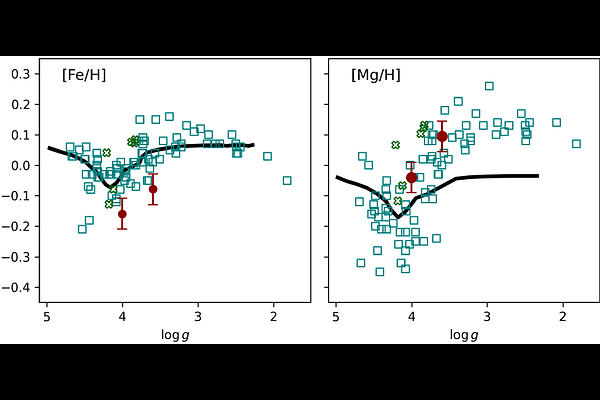
AbstractAI Phe is an eclipsing binary star with an orbital period of 24.6 days for which the surface gravity and effective temperature are known from direct measurements to very high precision and accuracy. We have obtained high-quality spectroscopy of the K0IV star during the total eclipse of the F7V companion, and also obtained spectra with a very high signal-to-noise ratio for this star and its F7V companion using the spectral disentangling technique. We have used these spectra to measure the abundances of iron and magnesium for both stars. We compare the values of [Fe/H] and [Mg/H] for the F7V star and the K0IV star to stars in M67, an open cluster of similar age and metallicity to AI Phe. We find that our [Fe/H] and [Mg/H] measurements clearly show the signature of elemental diffusion in the F7V star. This suggests that AI Phe can be used to test models of single stars that include diffusion and mixing of elements.