NEO Colors from The Mission Accessible Near-Earth Object Survey (MANOS)

NEO Colors from The Mission Accessible Near-Earth Object Survey (MANOS)
Nicholas Moskovitz, Theodore Kareta, Samantha Hemmelgarn, Hannah Zigo, Maxime Devogèle, Audrey Thirouin, Katie Breeland-Newcomb, Brian Burt, Annika Gustaffson, Mitchell Magnuson, Michael Mommert, David Polishook, Robert Schottland, Brian Skiff, Cristina Thomas, Mark Willman
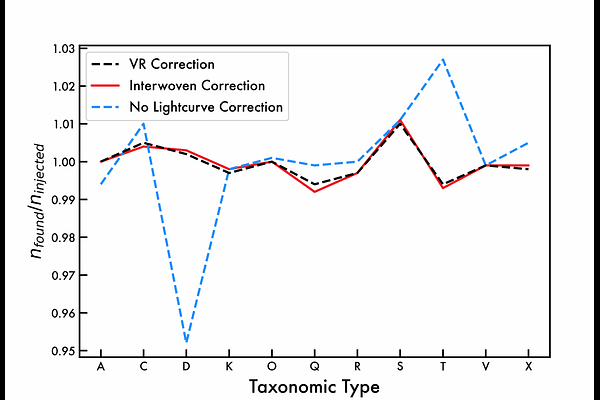
AbstractWe present spectro-photometric griz colors for 189 near-Earth objects (NEOs) collected by the Mission Accessible Near-Earth Object Survey (MANOS). Data acquisition involved non-simultaneous multi-band exposures, thus particular attention was given to the influence of rotational lightcurves on the derived colors. We show that colors measured without accounting for lightcurve variations can significantly influence results for individual objects and potentially have systematic offsets for ensemble studies. Color-based taxonomic classifications were used to investigate the distribution of spectral types. Our results were combined with other visible wavelength surveys to highlight a previously reported change in the observed taxonomic distribution of NEOs as a function of size, namely a decrease in S complex and an increase in X complex objects with increasing absolute magnitude. Plausibility arguments are given to suggest that Main Belt source region, thermal modification, discovery bias, tidal resurfacing, regolith grain size, and impact shock darkening are unlikely explanations for this size-dependent trend. Consistent with recent NEO population models and work on the connection between meteorites and young asteroid families in the Main Belt, this trend is best explained by a compositional gradient in the NEO population. In particular, the observed abundance of S complex or ordinary chondrite-like NEOs decreases by a factor of two from ~65% of the population at km-scales down to a third at sizes <50m. This result has implications for understanding the initial pre-impact population of meteorite parent bodies prior to atmospheric filtering. Furthermore, this will have implications for probabilistic impact risk assessment models.