Assembly of the essential SpoIVA coat protein at the surface of developing bacterial spores

Assembly of the essential SpoIVA coat protein at the surface of developing bacterial spores
BAUDA, E.; FEKADE, B.; BELLARD, L.; GALLET, B.; DEGROUX, S.; NEUMANN, E.; MAS, C.; COLEMAN, K.; Le ROY, A.; EFFANTIN, G.; FENEL, D.; MORAVCOVA, J.; NOVACEK, J.; MORISCOT, C.; SCHOEHN, G.; Rodrigues, C. D.; Morlot, C.
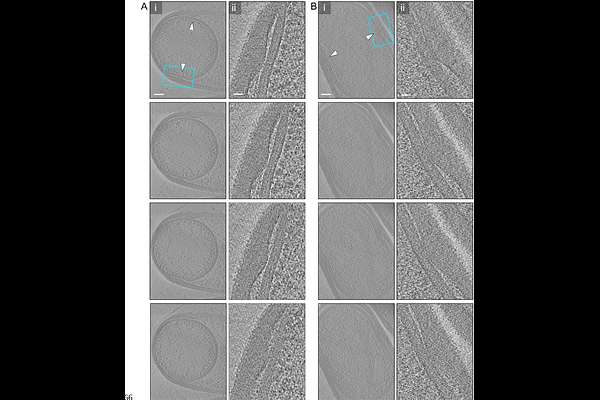
AbstractBacterial spores owe their remarkable resistance properties to a multilayered coat, one of the most resilient and durable biological structures on Earth. Assembled at the surface of the outer forespore membrane, the coat comprises dozens of proteins organized into distinct layers. Its formation is initiated by SpoIVA, which is proposed to form a polymeric scaffold for the innermost coat layer. Although SpoIVA has been shown to polymerize into filaments in vitro, there is currently no evidence demonstrating the formation of such assemblies in vivo, and the mechanism underlying its oligomerization remains unresolved. In this study, cryo-focused ion beam milling combined with cryo-electron tomography of sporulating Bacillus subtilis cells reveals that the SpoIVA layer consists of polymers that form track-like structures radiating from the mother cell-proximal forespore pole and extending directionally toward the distal pole. Subtomogram averaging further sheds light on their organized architecture, harboring a straight orientation, uniform spacing, and embedding in the outer forespore membrane. These observations also define SpoIVA spatial orientation relative to the outer forespore membrane. Furthermore, AlphaFold3 predictions, combined with biophysical and functional assays, show that SpoIVA dimerizes through its central and C-terminal regions. We further show that dimerization promotes SpoIVA localization around the forespore but is dispensable for polymer formation, which relies on the ATPase domain. Altogether, these findings suggest a dual oligomerization mechanism, in which SpoIVA transitions from dimers to linear track-like polymers, and reveal that these assemblies play critical roles in coat assembly and spore development.