Behavioral characterization of dynamic facial expression perception in rhesus monkeys (Macaca mulatta) using naturalistic and synthetic stimuli

Behavioral characterization of dynamic facial expression perception in rhesus monkeys (Macaca mulatta) using naturalistic and synthetic stimuli
Siebert, R.; Taubert, N.; Giese, M. A.; Thier, P.
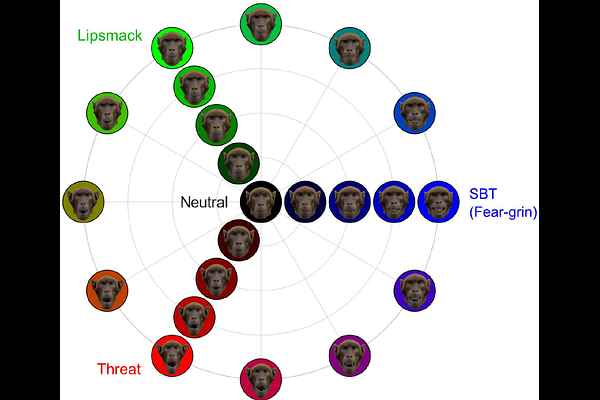
AbstractFacial displays are an important channel of communication for primates, yet it remains unclear based on which criteria monkeys evaluate facial expressions. We trained two rhesus macaques to categorize videos of four facial expression types (neutral, lip-smacking, silent bared-teeth (SBT) and open-mouth threat displays) and then tested generalization to novel individuals and avatars while measuring pupillary responses. Monkeys were able to sort facial expressions into categories and generalized to new, untrained videos, albeit imperfectly. Confusions did not occur due to visual similarity between expressions, demonstrated through a novel automated method integrating deep learning-based motion tracking with the Macaque Facial Action Coding System, enabling objective quantification of facial action units. Instead, open-mouth threats were readily categorized as such and distinguished from lip-smacking while eliciting strongest arousal, consistent with an innate predisposition for threat detection. By contrast, categorization of SBT displays varied substantially across stimulus identities, influenced by body weight, gaze direction, and coordinated movements of eyebrows and ears. Morphed avatar expressions were categorized according to expression component intensity, demonstrating graded perception. Avatar manipulations revealed that categorization was robust against lack of coherent motion, lack of realism beyond a basic level of texture, and mostly transcended species form boundaries to a human face. However, human facial expressions elicited random categorizations and no differential arousal, highlighting the necessity of species-specific facial motion. These findings demonstrate that rhesus macaques perceive facial expressions as functionally meaningful, context-dependent social signals shaped by both the expression itself and signaler characteristics, rather than fixed morphological categories.