A Novel Operant Conditioning Task to Assess Motivation to Exercise in Rats

A Novel Operant Conditioning Task to Assess Motivation to Exercise in Rats
Seib, D. R.; Liu, M. Q.; Tobiansky, D. J.; Floresco, S. B.; Soma, K. K.
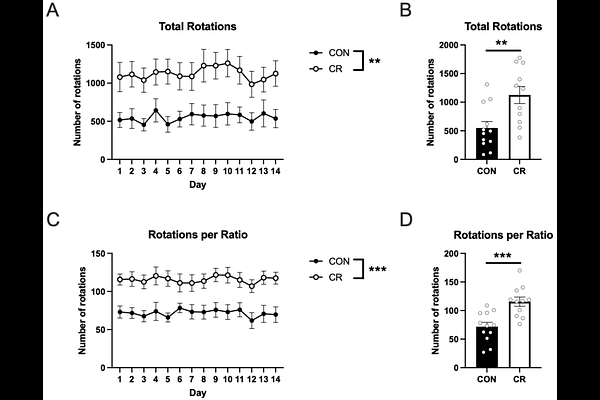
AbstractVoluntary physical activity is a highly motivated behavior with important implications for physical and mental health, yet the neural and endocrine mechanisms underlying motivation to exercise remain poorly understood. In contrast, motivation for sugar/palatable foods, drugs, and sex has been extensively characterized using operant paradigms. Here, we describe a novel progressive ratio operant task to measure motivation to run, independent of running ability. Using female Long Evans rats, which exhibit robust voluntary running behavior, we validated this paradigm by applying a manipulation well known to enhance the motivation to run: calorie restriction. Calorie-restricted animals exhibited increased operant responding to gain access to a running wheel, thus demonstrating heightened motivation for exercise. More specifically, calorie-restricted rats completed more ratios, reached a higher breakpoint in the progressive ratio task, ran more, and spent more time in the operant chamber. We did not observe any effects of calorie restriction on the estrous cycle or steroids (e.g. corticosterone, testosterone) in the blood or brain. Importantly, our task dissociates the motivational drive for physical activity from the ability to perform the physical activity itself, providing a new paradigm for studying the neural and endocrine mechanisms that regulate exercise motivation.