Engineering a bifunctional alfa and beta hydrolase from a GH1 beta-glycosidase

Engineering a bifunctional alfa and beta hydrolase from a GH1 beta-glycosidase
Otsuka, F. A. M.
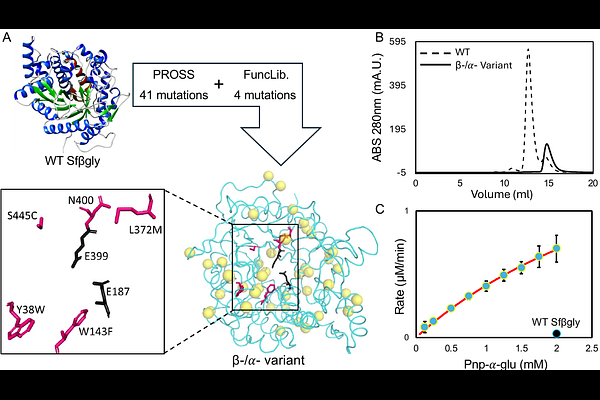
AbstractGlycoside hydrolases (GHs) play central roles in carbohydrate metabolism and are widely exploited for industrial and biomedical applications. However, they are often not optimal for applications due to their constrained function and strict stereochemical specificity, necessitating the discovery and optimization of distinct enzymes for each glycosidic configuration. Members of glycoside hydrolase family 1 (GH1) are archetypal retaining {beta}-glycosidases, while -specific activity is rare within this family. Here, I demonstrate that a retaining GH1 enzyme can be engineered to hydrolyze both {beta}- and -configured substrates without altering its canonical catalytic residues. Using a well-characterized {beta}-glycosidase and computational protein design strategies targeting second-shell residues surrounding the active site, a bifunctional {beta}-/-glycosidase containing 45 mutations was generated. The engineered variant acquired the ability to hydrolyze the -configured substrate 4-nitrophenyl--D-glucopyranoside while retaining activity toward the originals {beta}-substrates, with reduced catalytic efficiency and thermostability. Structural modeling and docking analyses reveal that the engineered enzyme preserves the original fold and accommodates substrates within the catalytic pocket in a similar manner to the wild type. These findings provide direct evidence that stereochemical constraint in retaining GH is more flexible than previously appreciated and can be modulated through targeted engineering.