Can third- and fourth-order multipoles plus radial variation of iso-density ellipses explain the observed flux ratios in B1422$+$231? YES, and a lesson learned from a TNG100 lensing galaxy sample

Can third- and fourth-order multipoles plus radial variation of iso-density ellipses explain the observed flux ratios in B1422$+$231? YES, and a lesson learned from a TNG100 lensing galaxy sample
Ruizhe Feng, Dandan Xu, Dominique Sluse, Giulia Despali, Anowar Shajib, Cai-Na Hao
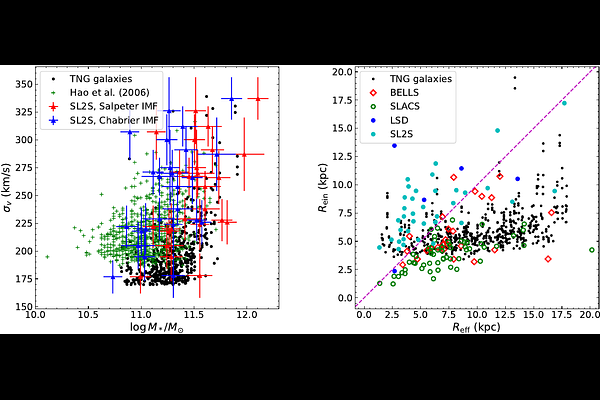
AbstractFlux ratio anomalies in multiply-imaged quasar lenses are a long-standing issue. Using a classical system B1422+231 as a case study, we investigate how typical non-clumpy perturbations beyond elliptical shapes -- multipoles $m_3, m_4$ and radial variations in $q, φ_q$ -- can account for the observed image positions and flux ratios under different observational precisions. We extract these perturbations from a pre-selected strong-lensing galaxy sample from the TNG100 simulation. Smooth macroscopic models (SIE+$γ$, EPL+$γ$) are then fitted to the observed image positions alone and to both positions and flux ratios, with and without including the extracted perturbations. With astrometric uncertainty of $σ_{p}=10$ mas, both macro-models alone can already successfully fit image positions within $3σ_{p}$. At $σ_{p}=2$ mas, however, 'astrometric anomalies' appear if smooth macro-models alone are adopted. In this case, adding the extracted perturbations can explain the anomalous image positions. When both positions and flux ratios are adopted, the SIE+$γ$ model family already shows 'flux ratio anomalies' at photometric uncertainty $σ_{f} \le 10\%$ (keeping $σ_{p}=10$ mas). When EPL+$γ$ is used, the smooth model alone can simultaneously fit both positions and flux ratios with $σ_{f}=10\%, 5\%$, but not with $σ_{f}=2\%$, where 'flux ratio anomalies' appear. Adding all four types of extracted perturbations can rescue the macro-models and explain the observed anomalous flux ratios. We present important lessons learned regarding model flexibility and degeneracy.