Discriminating Planck Reionisation Histories with the kSZ Effect

Discriminating Planck Reionisation Histories with the kSZ Effect
M. Douspis, A. Gorce, S. Ilić, L. McBride, M. Muñoz-Echeverría, E. Pointecouteau, L. Salvati, M. Tristram
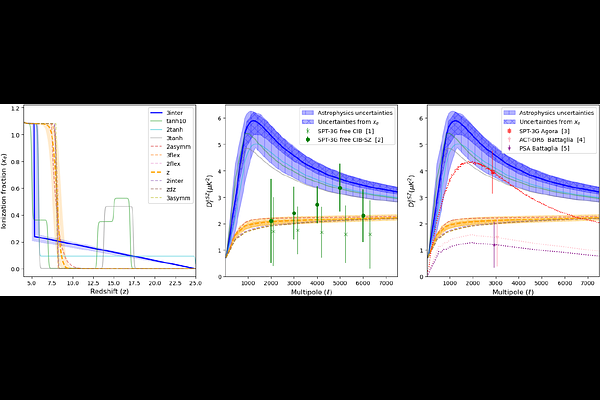
AbstractThe epoch of reionisation is a key phase in cosmic history, but its detailed evolution remains poorly constrained by current cosmic microwave background (CMB) observations. We investigate whether the kinetic Sunyaev--Zel'dovich (kSZ) effect can discriminate among reionisation histories consistent with current large-scale CMB constraints. Using histories derived from Planck data, we compute the corresponding kSZ angular power spectra within an analytical framework, separating late-time and patchy contributions and accounting for uncertainties in both the ionisation history, $x_e(z)$, and astrophysical parameters constrained by the LORELI II simulations. The allowed histories fall into two broad classes, `short' and `long' duration reionisation, yielding distinct kSZ signatures. Uncertainties from $x_e(z)$ and astrophysical parameters produce comparable amounts of dispersion, yet the two classes remain clearly separable, with variations within each class at the $\sim$10\% level. Current kSZ measurements ($\sim$0--3 $μ$K$^2$) are not yet precise enough to distinguish between these scenarios, although they tend to favor a `short' reionisation. The kSZ effect thus provides a promising probe of reionisation beyond optical depth constraints. In particular, a measurement of the kSZ power spectrum at $\ell \sim 2000$ with $\sim$0.4 $μ$K$^2$ sensitivity would discriminate between `short' and `long' reionisation scenarios.