Recurrent inhibition, not presynaptic inhibition, contributes to the velocity-dependent control of motoneuron output during eccentric contractions

Recurrent inhibition, not presynaptic inhibition, contributes to the velocity-dependent control of motoneuron output during eccentric contractions
Colard, J.; Nosaka, K.; Latella, C.; O'LOUGHLIN, J.; Cattagni, T.; Jubeau, M.
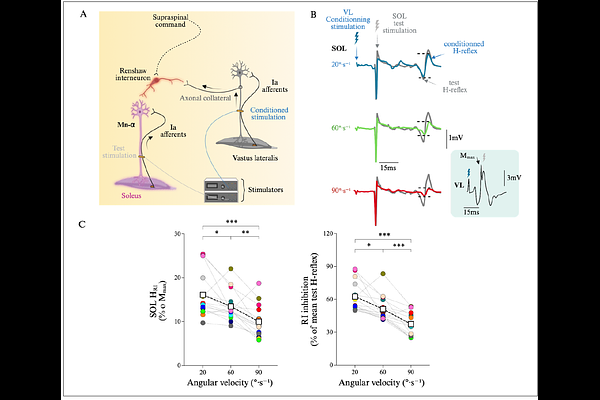
AbstractIt is well documented that both motoneuron output and the effectiveness of activated Ia afferents to discharge soleus -motoneurons decrease during eccentric (muscle lengthening) contractions. Evidence suggests that these modulations can be explained by recurrent inhibition and greater presynaptic inhibition of Ia afferents. However, the influence of angular velocity on the modulation of the effectiveness of activated Ia afferents to discharge -motoneurons observed during eccentric contractions remains unclear. We investigated the influence of angular velocity on spinal mechanisms involved in the effectiveness of activated Ia afferents to discharge -motoneurons during eccentric plantar flexor contractions using 16 healthy adults. We used both simple and conditioned Hoffmann reflexes with different conditioning techniques to assess presynaptic inhibition, heteronymous Ia facilitation and heteronymous recurrent inhibition coupled with electromyography during eccentric contractions of the plantar flexors at three angular velocities. Our results showed that during eccentric contractions, the effectiveness of Ia afferents to discharge -motoneurons was lower at 90{degrees}{middle dot}s-1 than 60{degrees}{middle dot}s-1 and 20{degrees}{middle dot}s-1 angular velocities. A similar velocity-dependent pattern was observed for heteronymous recurrent inhibition, decreasing at 90{degrees}{middle dot}s-1 when compared with 60{degrees}{middle dot}s-1 and 20{degrees}{middle dot}s-1. In contrast, presynaptic inhibition of Ia afferents was not different between the velocities. These findings demonstrate a differential influence of angular velocity on spinal recurrent inhibitory mechanisms during eccentric contractions and support distinct functional roles of recurrent and presynaptic inhibition in modulating -motoneuron discharge with increasing movement velocity. The findings provide new insights into the velocity-dependent and mechanism-specific modulation of spinal inhibitory circuits during eccentric contractions.