Eye movements reveal representational geometry

Eye movements reveal representational geometry
Collins, T.
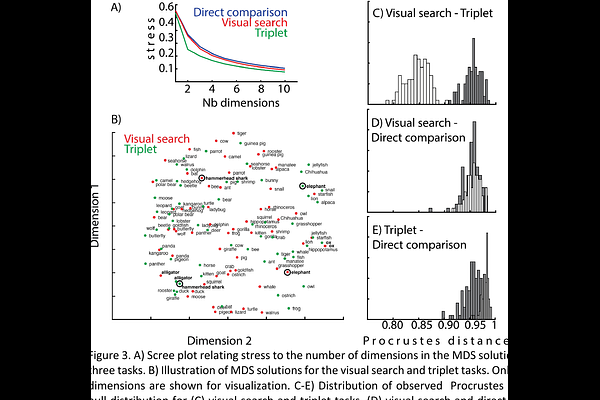
AbstractMental representations are the explanatory construct of the cognitive sciences, but there is no widely accepted characterization of how they cause behavior. Visual representational geometry can be quantified by similarity scores, but almost all methods require an explicit judgment. To examine how representations cause behavior by varying task demands, observers must perform different tasks while continuously reporting similarity, leading to dual-task interference. This study develops scanpaths as an implicit similarity measure, and uses representational similarity analysis to validate it. Observers searched for a target; fixations on distractors may reveal similarity. Similarity was also quantified by an odd-one-out task in the same participants, and ratings from different participants (Jiang et al. 2022). Representational geometries between tasks correlated. A generative model predicted first fixations in novel data. This double validation of the scanpath method opens the door to examining the causality of representations by determining if and how they vary with task demands.