A High-Bandwidth Backplane for Wideband Radio Interferometers and Integration with the CHORD Telescope Correlators

A High-Bandwidth Backplane for Wideband Radio Interferometers and Integration with the CHORD Telescope Correlators
Wellington Avelino, Joshua Montgomery, Jean-Francois Cliche, Graeme Smecher, Matt Dobbs
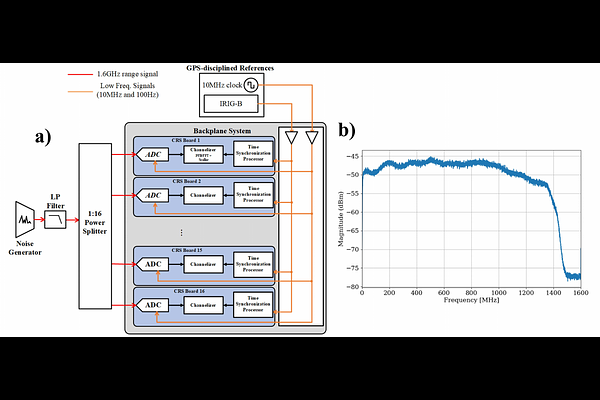
AbstractWide-band correlators for radio astronomy interferometers demand accurate, scalable signal processing backends that sustain high aggregate throughput while preserving stable timing alignment across a large number of signal chains. Addressing these coupled constraints is challenging without a co-designed backplane architecture. We present a backplane system developed for the Control Readout System (CRS) Field Programmable Gate Array (FPGA) platform, extending its capabilities to support high channel count wideband radio correlators. The design and validation process are guided by the requirements of the Canadian Hydrogen Observatory and Radio-transient Detector (CHORD) telescope, which provides a representative use case for the system's performance evaluation. Each backplane hosts up to four CRS boards, and a single crate integrates four interconnected backplanes to accommodate sixteen CRS modules (for a total of 128 digitized inputs per crate) interconnected through 25 Gbps per-lane links and an on-backplane data shuffle network. Comprehensive validation demonstrates robust high-speed link performance, sub-sampling-level timing alignment stability, and stable thermal and power behavior across environmental variations. The architecture delivers observatory-scale scalability, providing a low-jitter and phase-consistent foundation for wideband digital correlators. By supporting expansion from single-crate to multi-crate configurations without firmware modification, the system offers a practical and flexible path toward next-generation interferometers requiring tightly synchronized, high-throughput digital backends.