GRB 180728A and SN 2018fip: the nearest high-energy cosmological gamma-ray burst with an associated supernova

GRB 180728A and SN 2018fip: the nearest high-energy cosmological gamma-ray burst with an associated supernova
A. Rossi, L. Izzo, K. Maeda, P. Schady, D. B. Malesani, D. A. Kann, S. Klose, L. Amati, P. D'Avanzo, A. de Ugarte Postigo, K. E. Heintz, A. Kumar, V. Lipunov, A. Martin-Carrillo, A. Melandri, A. M. Nicuesa Guelbenzu, S. R. Oates, S. Schulze, J. Selsing, R. L. C. Starling, G. Stratta, D. Vlasenko, P. Balanutsa, R. Brivio, V. D'Elia, B. Milvang-Jensen, E. Palazzi, D. A. Perley, A. Rau, J. Sollerman, N. R. Tanvir, T. Zafar
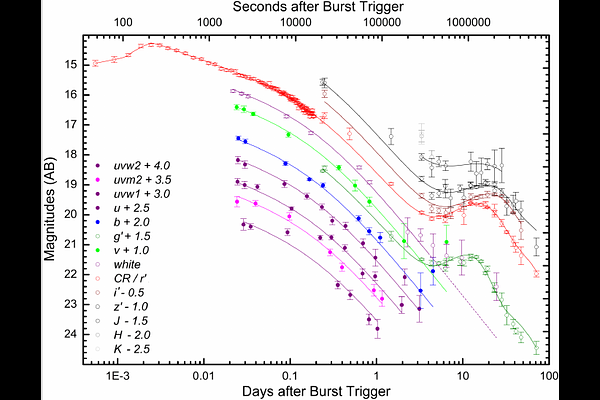
AbstractThe long GRB 180728A, at a redshift of $z = 0.1171$, stands out due to its high isotropic energy of $E_{γ,iso} \sim 2.5 \times 10^{51}$ erg, in contrast with most events at redshift $z<0.2$. We analyze the properties of GRB 180728A's prompt emission, afterglow, and associated supernova SN 2018fip, comparing them with other GRB-SN events. This study employs a dense photometric and spectroscopic follow-up of the afterglow and the SN up to 80 days after the burst, supported by image subtraction to remove the presence of a nearby bright star, and modelling of both the afterglow and the supernova. GRB 180728A lies on the $E_{p,i}-E_{γ,iso}$ plane occupied by classical collapsar events, and the prompt emission is one of the most energetic at $z < 0.2$ after GRB 030329 and GRB 221009A. The afterglow of GRB 180728A is less luminous than that of most long GRBs, showing a shallow early phase that steepens around 5 hours (0.2 days). The GRB exploded in an irregular, low-mass, blue, star-forming galaxy, typical of low-z collapsar events. Because of the relatively faint afterglow, the light curve bump of SN 2018fip dominates the optical emission already after $\sim$3 days and is one of the best sampled to date. The strong suppression below $\sim$ 4000 angstrom and a largely featureless continuum in the early 6--9 days spectra favor aspherical two-component ejecta with a high-velocity collimated component ($> 20,000 km s^{-1}$), dominant early-on, and a more massive, low-velocity component, which dominates at much later epochs. Our findings indicate that asymmetries need to be considered in order to better understand GRB-SNe. In any case, SN 2018fip shares many characteristics with typical GRB-SNe. Its kinetic energy is below the common range of $10^{52}-10^{53}$ erg and does not correlate with the high energy of the GRB, highlighting the diversity of the GRB-SN energy budget partition.