Breakdown of Rheological Universality in the Vegetal Hemisphere of Ascidian Embryos Mapped by Atomic Force Microscopy

Breakdown of Rheological Universality in the Vegetal Hemisphere of Ascidian Embryos Mapped by Atomic Force Microscopy
Miyata, Y.; Yamamoto, M.; Kotani, T.; Tsuboyama, Y.; Okajima, T.
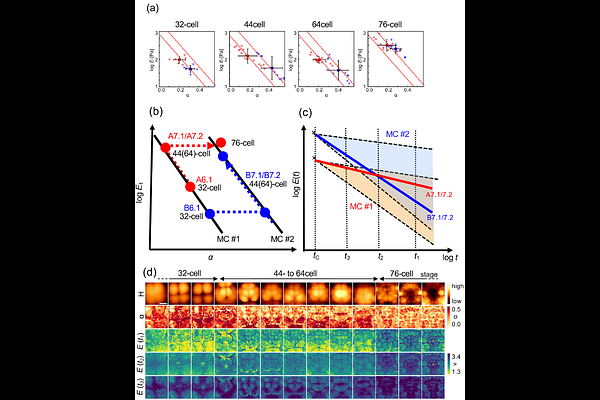
AbstractMechanical regulation plays an essential role in the organization of early embryogenesis. In ascidian embryos, cells in the animal hemisphere exhibit periodic stiffening-softening cycles, and their cell rheological properties follow a common master curve, indicating a form of universality. In contrast, cells in the vegetal hemisphere show cell-to-cell differences in stiffness even within the same endodermal lineage, but their rheological behavior has not been characterized. Here, using atomic force microscopy (AFM), we investigated the spatiotemporal dynamics of single-cell power-law rheological states in the vegetal hemisphere during early cleavage. We found that both the elastic modulus (stiffness) and the fluidity (power-law exponent) differ among endodermal cells, and that these differences change in a stage-dependent manner. This result indicates that vegetal cells do not exhibit a single common rheological behavior, in contrast to animal hemisphere cells, suggesting that mechanical properties in the vegetal hemisphere are not uniformly regulated but are patterned in space and time during cleavage. Our findings indicate that this mechanical diversification is linked to the progression of early morphogenesis and may contribute to the emergence of distinct cell behaviors during development.