The Tsallis index of the human cortical transcriptome is invariant between bipolar II disorder and control: a pre-registered, cross-platform null with the disease question relocated to correlation structure

The Tsallis index of the human cortical transcriptome is invariant between bipolar II disorder and control: a pre-registered, cross-platform null with the disease question relocated to correlation structure
A MONTEIRO, S.; Alves Barbosa da Silva, F.
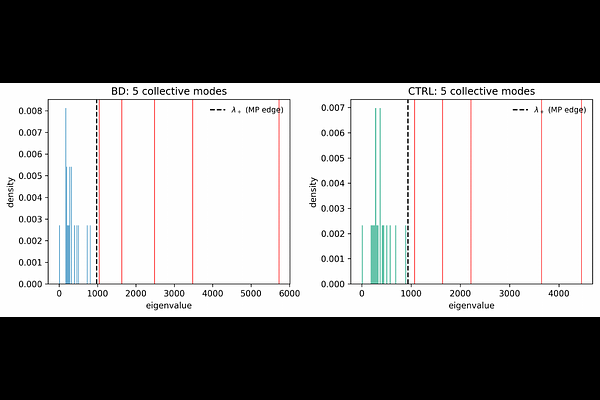
AbstractGene-expression fluctuations are heavy-tailed and resist description by additive (Boltzmann-Gibbs) statistics, motivating a non-extensive (Tsallis) account in which the index q summarizes the departure from Gaussianity. We ask two separable questions of the human cortical transcriptome in bipolar II disorder: whether the model-free value of q differs between cases and controls, and, if not, whether any disease signal instead resides in the correlation structure. Using a per-sample maximum-likelihood q-Gaussian estimator under a leakage-free, pre-registered protocol, we find the index concentrated near mean q ~ 1.37 (GSE80655), mean q ~ 1.33 (GSE12649), mean q ~ 1.35 (GSE53987), with no case-control difference in any cohort. Per-sample model comparison favours the q-Gaussian over a Gaussian in 99-100% of samples (median delta-BIC << 0), so q is a meaningful descriptor rather than an artefact of fitting. The BD-CTRL difference is null in every cohort. Pooling the three homogeneous cohorts, we test invariance by equivalence (TOST) rather than by non-rejection: the data establish equivalence at the bound |delta q| >= 0.037, but do not reach the pre-registered bound of 0.03, which would require roughly twice the present sample. We report this shortfall explicitly: the null is bounded and informative, but the study is underpowered against its own pre-registered minimum effect of interest. A random-matrix test finds no between-group structural difference surviving label permutation. We argue that non-extensivity behaves as a conserved organizational property of the cortical transcriptome and that the disease question, for bipolar II, is relocated from the marginal index to the collective correlation modes and to dynamics (companion work). We report, and do not paper over, a failed cross-tissue scale anchor: a glioma RNA-seq reference is depth-confounded in a cohort-inconsistent way and therefore cannot license a same-value claim across tissues.