The no-hair theorems at work in the tidal disruption event AT2020afhd

The no-hair theorems at work in the tidal disruption event AT2020afhd
Lorenzo Iorio
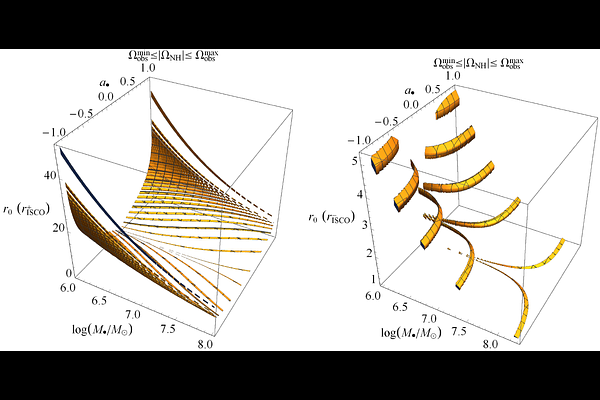
AbstractRecently, the coprecession of both the accretion disk and the jet formed following the tidal disruption event associated with the optical transient AT2020afhd, driven by a supermassive black hole of almost ten million solar masses, were independently measured in both the X and radio bands, respectively, showing a periodicity of nearly 20 days over about 300 days. An analytical model of the general relativistic gravitomagnetic Lense-Thirring precession of the effective orbit of a fictitious test particle revolving about a spinning primary can explain the observed precessional features. It yields allowed regions in the system's parameter space which, as far as the hole's dimensionless spin parameter is concerned, are essentially in agreement with those obtained in the literature with general relativistic magnetohydrodynamic simulations. The present analytical approach can be extended to include the precession due to the hole's quadrupole mass moment as well. It breaks the degeneracy in the allowed regions occurring for negative and positive values of the spin parameter when only the Lense-Thirring effect is considered. The best estimate for the hole's mass yields the range $0.185-0.215$ for the dimensionless spin parameter. Using the same strategy with the gravitomagnetic frequency for an extended disk of finite size with a parameterized power-law mass density yields to distinct, generally non-overlapping allowed regions for each value of the power-law index adopted.