Reversing aging-like 3D genome disorganization in a Drosophila interphase model

Reversing aging-like 3D genome disorganization in a Drosophila interphase model
Onufriev, A. V.; Zhang, J.; Sharakhov, I. V.; Tolokh, I. S.
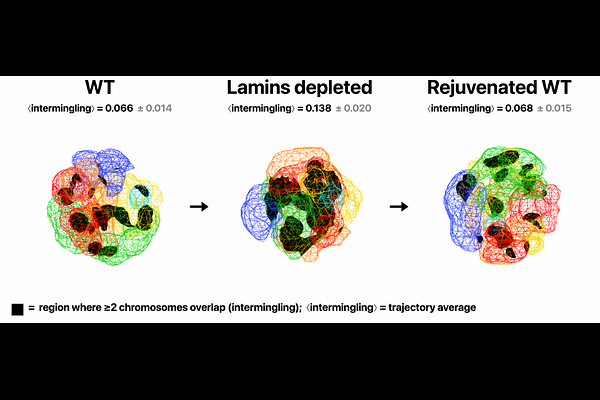
AbstractRecent experimental evidence suggests that aging may arise from the progressive deterioration of the epigenetic landscape, while reversing the trend can result in cell and tissue rejuvenation. A mechanistic understanding of how restoration of a key component of this landscape - the 3D structure of the genome - can be accomplished is lacking. Here we investigate lamina-dependent disruption and recovery of the 3D architecture of the Drosophila melanogaster genome at TAD resolution ([~] 100kb), using a model of the entire nucleus; weakening of chromatin-lamina interactions mimics an aging-associated loss of chromatin organization. We characterize this loss using the Shannon entropy of appropriately normalized Hi-C contact matrices. Our main finding is that lamina-depletion-induced increases in Hi-C map disorder, deterioration of chromosome territories, and cell-to-cell conformational heterogeneity are largely reversible when WT-like LAD-nuclear-envelope interactions are restored. The original and recovered conformational states of chromatin are nearly indistinguishable by bulk Hi-C contact matrix; the corresponding Pearson correlation coefficient is 0.999902. The direct experimentally testable prediction is that restoration of functional LAD-lamina interactions will promote recovery of young/WT-like 3D chromatin architecture after lamina-dependent architectural disruption.