Harmonizing Peak Matching Between Multidimensional NMR Spectra

Harmonizing Peak Matching Between Multidimensional NMR Spectra
Bishop, A. C.; Mimun, K.; Tan, W.; Cole, T. R.; Wand, A. J.
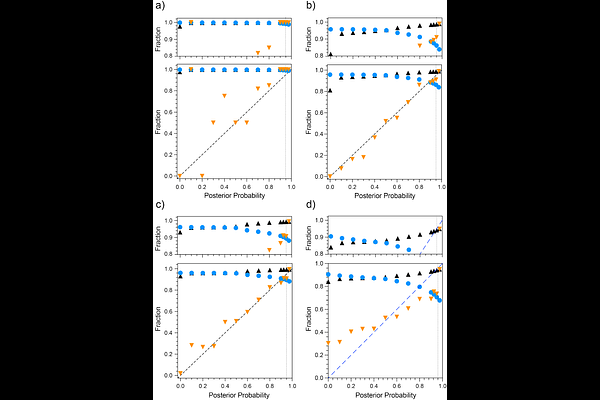
AbstractA common task in analysis of multidimensional NMR is the mapping of cross-peaks from one spectrum to another. In some situations, only a subset of coordinates of cross-peaks are to be matched such as in comparing corresponding dimensions of triple resonance assignment spectra. In other cases, the sample is perturbed in some way, and the task is to map corresponding cross-peaks that potentially change in any and all dimensions. This exercise is commonly done by hand and is both time-consuming and subjective. It is difficult for an individual to consider all possible interpretations of deviations between two multidimensional NMR spectra. Furthermore, in regions of high degeneracy, cross-peak matchings between spectra can be ambiguous. Ideally, a mapping algorithm should reflect a confidence of its matchings to indicate the reliability of proposed matchings and should do so while harmonizing all potential mappings in the spectrum. Critically, this process should be automated using criteria that are both well-defined, consistent and provide a measure of reliability. Here we develop a novel model describing the distribution of apparent deviations between cross-peaks of two multidimensional NMR spectra to random noise and true deviations to harmonize the cross-peak matching. Bayesian inference is employed to provide confidence estimates. The resulting algorithm (pHarmony) is tested in a variety of ways such as mapping between pairs of triple resonance spectra and between two- and three-dimensional heteronuclear NMR spectra generated by a fragment-based ligand discovery screen.