TRIM28 preserves ovarian identity by stabilising lineage-specific transcription factor hubs

TRIM28 preserves ovarian identity by stabilising lineage-specific transcription factor hubs
Sitkiewicz, L.; Chaleil, F.; Granes, G.; Rossitto, M.; Dejardin, S.; Cammas, F.; Lefrancois-Martinez, A.-M.; Stevant, I.; Poulat, F.
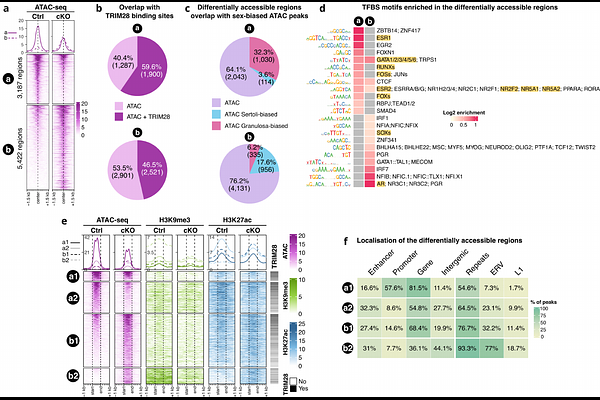
AbstractMaintenance of ovarian cell identity is required throughout life to prevent the activation of the testicular programme, but the epigenetic mechanisms underlying this process remain poorly understood. Although TRIM28 is required to prevent granulosa-to-Sertoli transdifferentiation, it can act both as a regulator of H3K9me3-dependent heterochromatin and as a transcriptional co-regulator through its E3 SUMOligase activity. Here, we combined CUT&RUN, ATAC-seq and RNA-seq to define the respective contributions of these activities to maintain ovarian cell identity. Strikingly, only a small fraction of TRIM28-bound regions was associated with H3K9me3. Although Trim28 deletion induced focal H3K9me3 loss, it had limited transcriptional consequences and primarily affected repetitive elements rather than regions controlling testis-determining genes. In contrast, Trim28 loss led to reductions in chromatin accessibility and H3K27ac at regions enriched for ovarian transcription factor (TF) motifs FOXL2, NR5A2, ESR2 and RUNX1. Moreover, TRIM28 was frequently co-localised with these factors on chromatin, and the accessibility these co-bound regions were reduced by Trim28 deletion. Finally, SUMOylation loss was observed in regions co-occupied by TRIM28 and the ovarian TFs. Together, our findings identify TRIM28 as a central organiser of ovarian TF hubs whose predominant function is to preserve granulosa cell identity through stabilisation of lineage-specific TFs rather than H3K9me3-dependent heterochromatin.