Regulation of Nucleus Pulposus Cell Phenotype Through RhoA Signaling and Microenvironment

Regulation of Nucleus Pulposus Cell Phenotype Through RhoA Signaling and Microenvironment
Bond, G.; Kim, M. K. M.; Lisiewski, L.; Jacobsen, T.; Chahine, N.
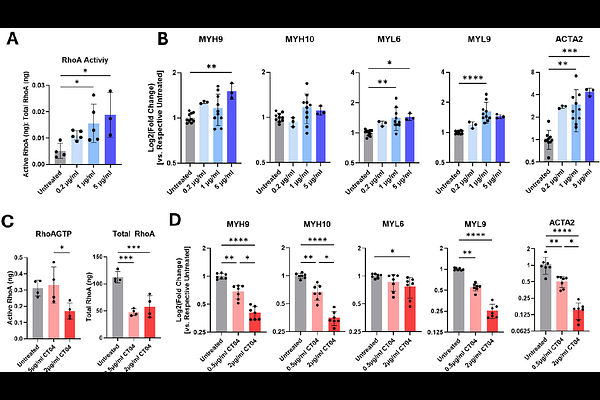
AbstractIntervertebral disc degeneration is associated with loss of nucleus pulposus (NP) cell phenotype and extracellular matrix, both processes linked to changes in cytoskeletal contractility and cell shape. Here, we tested whether microenvironment-specific modulation of RhoA signaling can restore NP-like morphology and gene expression in NP cells cultured in 2D and in 3D alginate. In 2D monolayer culture, where cells are spread and mechanically activated, pharmacologic inhibition of RhoA with CT04 reduced RhoA activity, decreased actomyosin contractility gene expression, and shifted morphology toward a smaller, more circular phenotype. Bulk RNA sequencing showed that CT04 treatment increased expression of NP phenotypic and matrix-related genes including ACAN, GDF5, CHST3, and MUSTN1 while decreasing expression of catabolic and fibroblast-associated genes including ADAMTS1/9 and COL1, consistent with enrichment of extracellular matrix pathways. In contrast, RhoA activation with CN03 in 2D culture increased actin and phosphorylated myosin light chain intensity but produced limited phenotypic improvement. In 3D alginate, which minimizes integrin-mediated adhesion, baseline actomyosin markers were reduced relative to 2D culture. In alginate, RhoA activation with CN03 increased the amount of actin, phosphorylated myosin light chain, and actomyosin gene expression, yet also promoted a more compact, circular morphology and increased NP markers, including ACAN and KRT19 with repeated dosing. Across culture conditions, increased cell roundness was consistently associated with increased ACAN expression, indicating strong coupling between cytoskeletal state, morphology, and NP matrix programs. Together, these findings demonstrate that RhoA pathway perturbation can promote NP phenotypic gene expression in both 2D and 3D culture, but the direction of optimal modulation depends on the microenvironment, supporting RhoA signaling as a context-dependent therapeutic target for disc regeneration.