Remnant recoil and host environments of GWTC-4.0 binary black-hole mergers

Remnant recoil and host environments of GWTC-4.0 binary black-hole mergers
Joan Llobera-Querol, Eleanor Hamilton, Neha Singh, Marta Colleoni, Felip A. Ramis Vidal, Abbas Askar, Tomasz Bulik, Aleksandra Olejak, Sascha Husa, Yumeng Xu, Jorge Valencia
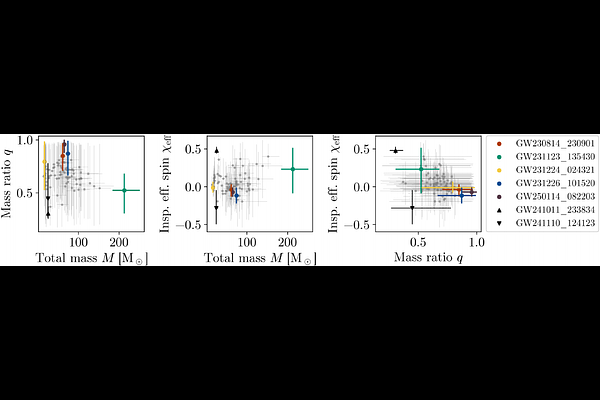
AbstractDetermining the astrophysical origin of binary black holes and whether merger remnants are retained in their birth environments is essential for understanding hierarchical mergers and the growth of intermediate-mass black holes. We identified the gravitational-wave (GW) events most consistent with dynamical formation and assessed whether their merger remnants are retained in globular clusters, nuclear star clusters, or galactic potentials. We considered the 84 events consistent with binary-black-hole (BBH) mergers from the first part of the fourth observing run (O4a) of the LIGO-Virgo-KAGRA (LVK) GW detector network, and 3 selected events from the second part (O4b). We compared parameter-estimation posteriors with synthetic population models for field and cluster binaries using Bayes factors, accounting for the relative abundances of these formation channels in the local Universe. We computed recoil-velocity posteriors for all events using the IMRPhenomXPNR waveform model, which incorporates multipole asymmetries. We identified five events showing preference for a dynamical origin, including the most massive O4a event GW231123_135430, while excluding the high-spinning O4b event GW241011_233834. Typical recoil velocities of analyzed events are of order a few hundred km/s, with extended high-velocity tails. These kicks suggest that merger remnants are likely ejected from typical globular clusters, while retention in nuclear star clusters remains possible but not guaranteed. Our results disfavour efficient hierarchical growth in globular clusters, whereas nuclear star clusters remain viable environments for repeated mergers. Although results depend on the adopted astrophysical population models, this analysis highlights the importance of improved and larger population models, as well as higher-quality detections enabled by future developments in GW detectors.