JWST Medium-Resolution Infrared Spectroscopy of SN 2022acko: Tracing Molecule Formation in the Nebular Phase

JWST Medium-Resolution Infrared Spectroscopy of SN 2022acko: Tracing Molecule Formation in the Nebular Phase
K. Medler, T. Mera, C. Ashall, P. Hoeflich, E. Baron, M. Shahbandeh, J. M. DerKacy, E. Fereidouni, C. M. Pfeffer, S. Shiber, P. Brown, C. Burns, A. Cikota, T. de Jaeger, A. Do, D. O. Jones, L. Galbany, W. B. Hoogendam, E. Hsiao, K. Krisciunas, S. Kumar, J. Lu, P. Mazzali, N. Morrell, M. Phillips, B. Shappee, M. D. Stritzinger, N. Suntzeff, M. Tucker, L. Wang, Y. Yang
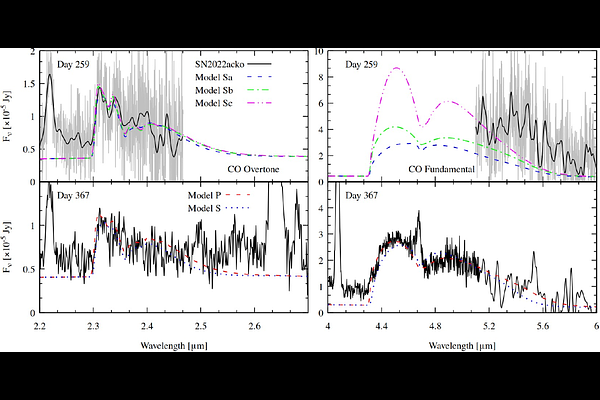
AbstractThe Type II supernova (SN II) SN 2022acko was the first to be spectroscopically observed by the James Webb Space Telescope ($\textit{JWST}$). Here, we analyze SN 2022acko's second and third $\textit{JWST}$ spectra obtained at $+259$ and $+368$ d. We identify strong features associated with hydrogen along with Intermediate-Mass and Iron-Group Elements (IM/IGEs). The medium-resolution mode of $\textit{JWST}$/MIRI uniquely enables the isolation of emission features, allowing us to determine the structure of SN 2022acko, directly coupling the spectroscopic features and the explosion mechanism. We find that IMEs display peak velocities of $~ 300$ km s$^{-1}$, significantly larger than the $~ 100$ km s$^{-1}$ measured for H, He, and IGEs. We suggest a bipolar outflow best explains this ejecta distribution, although Rayleigh-Taylor instabilities may also contribute. Additionally, we find a bulk velocity offset of $~ 97.4^{+86.3}_{-42.3}$ km s$^{-1}$ in the ejecta which we associate with the natal kick of a neutron star. CO emission is also detected while no SiO or dust signatures are observed. We fit the CO first-overtone and fundamental bands with MOFAT and find a clumped distribution is required with a CO mass increasing from $1.55\times10^{-4}$ M$_{\odot}$ at $+259$ to $2.47\times10^{-4}$ M$_{\odot}$ at $+368$ d. This CO mass is approximately an order of magnitude lower than that of SN 2024ggi. As the first $\textit{JWST}$ nebular-phase study of a low-mass SN II, this work shows that such events form substantially less molecules than more massive SNe II, with dust formation likely occurring on longer timescales, if at all.