A Rare T-Cell Factor 4 Lineage-negative Epithelial Stem Cell Supports Wound Repair and APC-deletion-induced Colon Tumorigenesis

A Rare T-Cell Factor 4 Lineage-negative Epithelial Stem Cell Supports Wound Repair and APC-deletion-induced Colon Tumorigenesis
Thorpe, A. V.; Mosbruger, T.; Georges, S. J.; Crowley, O. M.; Tuohy, T.; Dalley, B.; Bice, B. D.; Fuller, A. K.; Hidalgo, J. R.; Green, C. D.; Hammoud, S. S.; Angus-Hill, M. L.
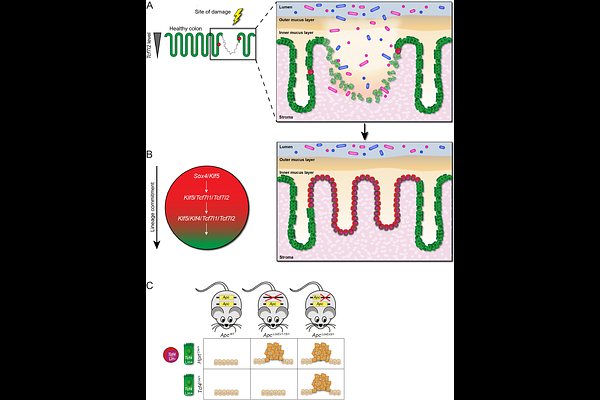
AbstractTo maintain barrier homeostasis, the colonic and intestinal epithelial lining is continually renewed by rapidly proliferating epithelial crypt base columnar (CBC) stem cells that reside at the base of crypts. Using mouse lineage tracing, immunohistochemistry, and single-cell sequencing, we have identified a rare, non-CBC, T-cell factor 4 lineage-negative (Tcf4 Lin-) stem cell population that gives rise to secretory and absorptive precursors. Following endoscopic biopsy-induced injury, Tcf4 Lin- stem cells are recruited to the wound bed and to the site of expanding crypts and function in barrier restoration and wound repair. We show that in a Tcf4-haploinsufficient background, the Tcf4 Lin-, but not the Tcf4 Lin+, cell population represents the cell of origin for colon tumors driven by deletion of Apc. Our results provide a foundation for understanding Apc-allele-specific differences during colon tumorigenesis and identify a new stem-cell population that may prove valuable in the treatment of diseases caused by intestinal barrier homeostasis defects.