Epstein Barr virus exploits ER stress and TMX4 dependent nuclear envelope remodeling to enable capsid egress

Epstein Barr virus exploits ER stress and TMX4 dependent nuclear envelope remodeling to enable capsid egress
Kucinska, M. K.; Solda, T.; Morone, D.; Raimondi, A.; Molinari, M.
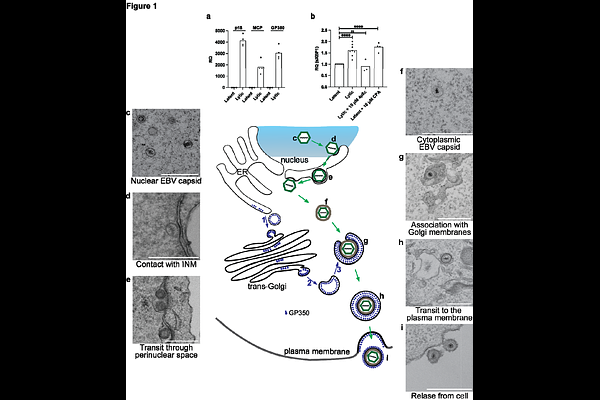
AbstractHerpesvirus capsids assemble within the nucleoplasm of infected cells in highly ordered icosahedral structures with a diameter of about 100nm. Despite the small distance between outer and inner nuclear membrane, which is fixed between the 25 and the 50nm by disulfide bonded LINC complexes, the capsid particles cross the barrier and are delivered into the cytoplasm, where viral particle assembly continues. How Epstein Barr virus (EBV) overcomes the spatial constraints imposed by the narrow perinuclear space for nuclear egress of the viral capsids remains unclear. Here, we show that EBV exploits an ER stress responsive nuclear envelope (NE) remodeling pathway to promote capsid egress. Induction of EBV lytic replication activates the IRE1 branch of the unfolded protein response and triggers TMX4 dependent remodeling of the NE. Inhibition of IRE1 signaling or depletion of TMX4 prevents efficient redistribution of viral capsid proteins from the nucleus to the cytoplasm, causes accumulation of unused viral glycoprotein GP350 in Golgi-derived membranes, and markedly reduces production of infectious viral particles. Thus, EBV hijacks a host NE adaptation pathway to overcome a fundamental physical barrier during viral maturation.