Absolute quantitative proteomics guides patient-stratified drug repurposing in clear cell and papillary renal cell carcinoma.

Absolute quantitative proteomics guides patient-stratified drug repurposing in clear cell and papillary renal cell carcinoma.
Figueiredo, A. Q.; Domingos, I. F.; Lodeiro, C.; Dhir, R.; Carvalho, L. B.; Mercolini, L.; Wisniewski, J. R.; Moroncini, G.; Medeiros, M.; Pinheiro, L. C.; Mansinho, H.; Santos, H. M.; Korentzelos, D.; Capelo, J. L.
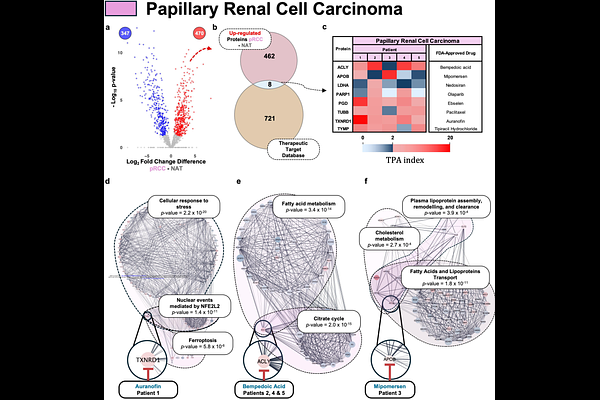
AbstractBackground Renal cell carcinoma (RCC) is a highly heterogeneous disease in which distinct molecular subtypes exhibit characteristic genomic, metabolic, and microenvironmental features that influence therapeutic response. Substantial inter-patient variability exists within each subtype, resulting in markedly different clinical outcomes even among tumours of the same histological category. Proteomics provides a direct readout of tumour biology and pathway activity, complementing genomic information and enabling the identification of patient-specific actionable vulnerabilities. We applied a Total Protein Approach (TPA)-based prescriptomics framework that integrates absolute quantitative proteomics with curated drug-target knowledge to nominate patient-specific drug-repurposing options, positioned as coadjuvants to the prevailing standard of care. Methods Seventeen human kidney tissue specimens, seven clear cell RCC (ccRCC), five papillary RCC (pRCC), and five normal adjacent tissues (NAT), were retrieved from the publicly available PRIDE repository (PXD023296) and reanalysed by TPA-based absolute quantification applied to previously acquired label-free LC-MS/MS data. Differential expression analysis between each tumour subtype and NAT identified subtype-specific upregulated proteins, which were intersected with Therapeutic Target Database (TTD) to nominate FDA-approved drugs targeting dysregulated proteins as candidate repurposing strategies. Results ccRCC and pRCC produced distinct proteome-wide upregulation profiles consistent with their known biological drivers. TPA index stratification nominated bempedoic acid (ACLY inhibitor) and tipiracil hydrochloride (TYMP inhibitor) as patient-stratified candidates for ccRCC, and auranofin (TXNRD1 inhibitor), bempedoic acid, and mipomersen (APOB-directed antisense oligonucleotide) for pRCC. ACLY was the only top-priority target shared across both subtypes, pointing to a candidate cross-subtype metabolic vulnerability. Secondary candidates emerged from protein-protein interaction network analysis in both subtypes. Conclusions This study presents a quantitative proteomics framework for translating individual-patient proteomic dysregulation into coadjuvant drug-repurposing hypotheses across the principal RCC subtypes. By combining the TPA for absolute protein quantification with prescriptomics-guided drug-target mapping, we show that ccRCC and pRCC harbour distinct, individually stratifiable therapeutic vulnerabilities. These findings provide a proof-of-concept for proteomics-based treatment stratification in RCC and establish a scalable framework that, pending functional validation, could inform personalised therapeutic decision-making across RCC subtypes.