Assembly-coupled feedback enables robust control of flagellar number

Assembly-coupled feedback enables robust control of flagellar number
Swiderski, R.; Rasshofer, F.; Angerpointner, S.; Graf, I.; Frey, E.
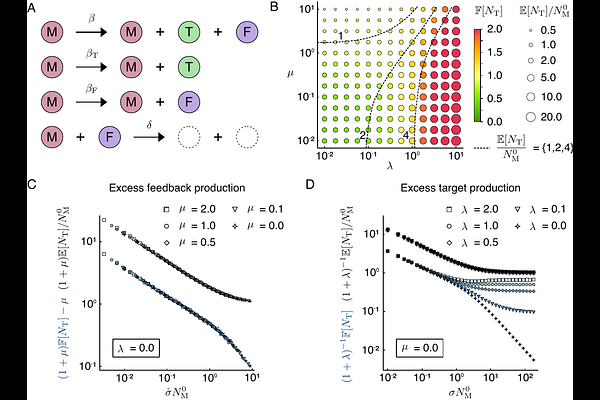
AbstractBacteria assemble a precise number of flagella to navigate their environment, yet the molecular mechanisms underlying this robust counting remain poorly understood. We propose that robust flagellar number control does not require a strictly conserved transcriptional gene hierarchy, but instead emerges from a conserved network motif in which transcriptional feedback is coupled to the assembly progress of the flagellar C-ring. Specifically, upon C-ring growth, the ATPase FlhG is released from a non-inhibitory FlhG-FliM complex, dimerizes, and inactivates the master regulator FlrA, shutting down early flagellar gene expression. We analyze this assembly-coupled feedback mechanism using stochastic simulations and analytical calculations, revealing a trade-off between robustness to intrinsic fluctuations and to cell-to-cell variability in regulator abundance. Only at the crossover between fast and slow inactivation regimes can robustness to both noise sources be achieved simultaneously. These results provide quantitative, organism-independent insight into flagellar number control and connect to the broader problem of stochastic regulation of absorbing-state statistics.