Voclosporin Preserves Mitochondrial Function Compared With Cyclosporine A in Perfused Human Proximal Tubule Microphysiological Systems

Voclosporin Preserves Mitochondrial Function Compared With Cyclosporine A in Perfused Human Proximal Tubule Microphysiological Systems
Aryeh, K. S.; Tsang, Y. P.; Hsu, E. W.; Yeung, C. K.; MacDonald, J.; Bammler, T. K.; Himmelfarb, J.; Rehaume, L. M.; Kelly, E. J.
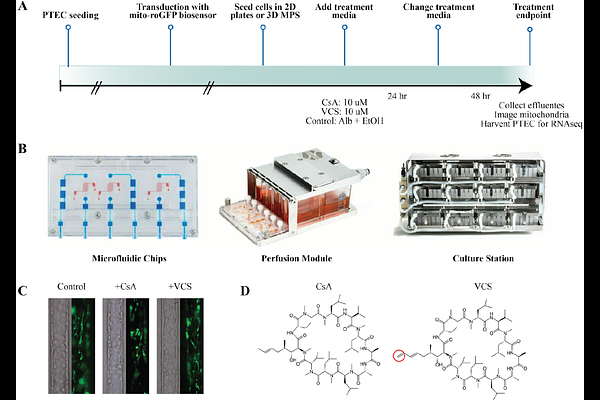
AbstractAbstract Background: Calcineurin inhibitors (CNIs) are indispensable for transplantation immunosuppression, yet cyclosporine A (CsA) produces renal toxicity. Voclosporin (VCS), a CsA analog, is proposed to be less nephrotoxic, but mechanisms remain unclear. Methods: Primary human proximal tubule epithelial cells (PTECs) were exposed to CsA or VCS in 2D monolayers and perfused 3D kidney microphysiological system (MPS). Viability was assessed in 2D cultures by MTS, mitochondrial membrane potential ({Delta}{Psi}m) by TMRM flow cytometry, and soluble injury and inflammatory biomarkers in MPS effluents by ELISA and MSD multiplex assays. RNA sequencing of 3D-cultured PTECs was used to identify differentially expressed genes and pathways. Results: In 2D PTECs, neither drug reduced viability. In 3D MPS effluents, KIM-1 did not distinguish CsA from VCS, whereas the MSD biomarker panel showed larger aggregate deviation with CsA. Confocal tomography showed CsA-associated mitochondrial fragmentation, whereas VCS preserved reticular mitochondrial architecture. TMRM flow cytometry showed a treatment-dependent difference in TMRM-positive cells, with VCS yielding the highest TMRM-positive fraction and exceeding CsA, supporting preservation of {Delta}{Psi}m relative to CsA. RNA-seq identified 1188 CsA-specific and 185 VCS-specific differentially expressed genes, with 304 shared. Pathway analysis indicated CsA enrichment of unfolded protein response (UPR) and endoplasmic reticulum (ER) stress, p21-associated G2/M checkpoint arrest, and transcriptional signatures consistent with ferroptosis priming, while VCS mainly induced ER chaperone and ER-associated degradation gene programs without activating canonical UPR sensors and showed limited cell-cycle suppression. Conclusions: A physiologically relevant 3D kidney MPS revealed sublethal tubular stress from CsA that is masked in 2D culture, including mitochondrial depolarization, proteostatic stress, and ferroptosis priming. At matched exposure, VCS preserved mitochondrial function and proteostasis while eliciting a narrower, adaptive ER quality control response. These data support VCS as a nephron-sparing immunosuppressant and 3D MPS as a mechanism-based platform for evaluating renal safety of drugs and nominating early sub-lethal tubular injury biomarkers.