Flow constraints at infection site shape multiplication-dissemination trade-offs and opposite regulatory programs of Xanthomonas and Ralstonia xylem pathogens

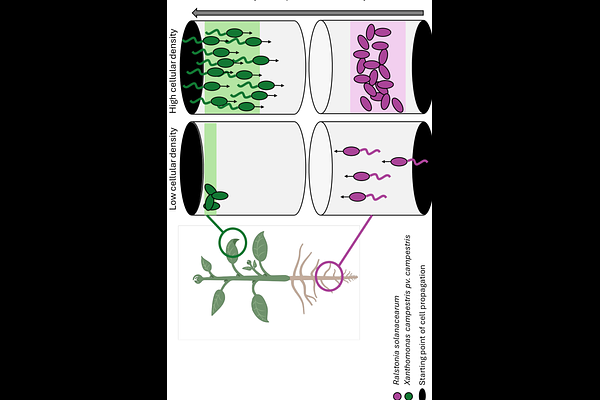
Flow constraints at infection site shape multiplication-dissemination trade-offs and opposite regulatory programs of Xanthomonas and Ralstonia xylem pathogens
Caddeo, A.; BARRET, M.; PEYRAUD, R.
AbstractPathogens rely on multiple pathogenicity traits, such as proliferation, adhesion, motility and the production of virulence factors, to successfully colonize their host. The expression of virulence functions is often finely regulated to mitigate resource allocation trade-offs due to their cost for the cell. The ways in which constraints encountered inside the host shape strategies for mitigating the trade-off between pathogenicity traits remain poorly understood. Xanthomonas campestris pv. campestris (Xcc) and Ralstonia solanacearum (Rs) are two bacterial phytopathogens that can colonize the same plant habitat, the xylem vessel, from two different infection sites, leaf and root, respectively. Analyses of the virulent regulatory networks (VRN) of Xcc and Rs revealed differences in the expression of their virulence programs in a cell density-dependent manner. Notably, swimming motility and exopolysaccharide production were regulated using opposite strategies. Simulation of bacterial dispersion in the vascular system through spatial model showed that these VRNs were adapted to the constraint of xylem sap flow. This study reports how strong environmental constraints, such as the direction of xylem sap flow, can shape opposite regulatory programs and strategies for mitigating trade-offs for pathogens colonizing the same ecological niche.